
20Beyond the Read
Up until now, we have been asking where BCI is going: what role it seems destined to play, why non-invasive reading matters, and why it has a natural synergy with AI. Now we turn the telescope around, instead of asking what BCI is becoming, we ask what kind of future it might create. First, we will zoom out beyond non-invasive reading and look at the rest of neurotechnology. Then we will move through the geopolitical consequences, the ethical minefield, and the strongest counterarguments against this manifesto. Finally, we will look at what the decade ahead holds before reaching the end of our journey.
Throughout this manifesto, we have been staring at one very specific corner of the map. We focused almost entirely on BCI. Within BCI, almost entirely on non-invasive systems. And within non-invasive systems, almost entirely on reading. In other words, we carved out one narrow slice of the vast neurotechnology landscape and mostly ignored everything else.
This was intentional.
Non-invasive reading is the commercial spark that will ignite the entire wildfire. It will act as a massive magnet for capital, talent, and public attention, dragging a reluctant and fragmented ecosystem into existence. It is upstream of the rest of the field.
However, the boundaries across this landscape are incredibly porous. The foundational pipelines built to decode messy, non-invasive waves transfer directly to clean, invasive data arrays. The hardware teams mastering consumer sensor manufacturing at volume are also building the expertise that can eventually produce surgical implants. The acceleration of non-invasive BCI will accelerate the rest of the field.
Every component of this broader neurotechnology matrix will eventually play a vital role in bridging the human-machine gap, maturing on a trailing timeline. While non-invasive reading is starting to hit escape velocity today, I expect consumer-grade write capabilities to follow in roughly five years, fully invasive BCI to hit true scale in nine years, whole brain emulation (WBE) to arrive within a 15-year horizon and neural augmentation within 20 years.
Each of those technologies will play a part in addressing the two major bottlenecks of the mind: how effectively we communicate and how quickly we can think. Over the next few years, BCI promises to substantially improve the communication layer, but ultimately, the biological limits of cognition will remain. Even a perfect brain-AI connection would not let a biological brain keep pace with a superintelligence. Addressing this second bottleneck means expanding cognition itself. This is where the broader neurotechnology field comes into play: neural augmentation and whole brain emulation could extend human cognitive capabilities beyond their biological limits, helping close the gap that better communication alone cannot bridge. This manifesto focuses on non-invasive BCI because it offers the most practical starting point, but neurotechnology’s role in the transition to AGI will reach beyond interfaces.
Let’s now explore the blind spots in neurotechnology that we have mostly ignored so far:
Writing to the Brain
For a true human-machine merge, reading the brain is only half the picture. The symbiosis we mapped earlier, where an AI seamlessly interacts with you at a higher conceptual abstraction level, implicitly relies on a two-way street. In the short term, the machine will just talk back to you through an earpiece or an AR display. But eventually, true symbiosis will require the ability to write directly back into the cortex.
Writing is a fundamentally different, and much harder, physics problem.
When we read the brain, we exploit a natural leakage. Neural activity casts faint electrical, magnetic, and hemodynamic shadows through the skull, which our sensors can catch. Stimulating a specific neuronal population through a closed skull, at the precision required to cause a thought rather than disrupt one, is a fundamentally different physical problem than reading. Writing does not have the same leakage in reverse: there is no equivalent path that lets you push a precise pattern into the cortex. Today, our write capabilities are poor. We can broadly stimulate large clusters of neurons, but we are far from elegantly injecting a specific, fine-grained thought. The brain is wildly chaotic, and altering it precisely from the outside remains an immense engineering hurdle.
But the write side of BCI is already making progress. Crude forms of non-invasive brain stimulation are already being used clinically to treat depression, OCD, and other circuit-level conditions. And within a few years, as the massive influx of capital and talent from the reading side of BCI spills over, we will see an acute acceleration of the development of brain writing technologies.
Invasive BCI
Beyond the write aspect, we have also spent most of this manifesto focused squarely on non-invasive hardware. Interacting with the brain from outside of the skull. But as we established earlier on the capability ladderThe capability ladder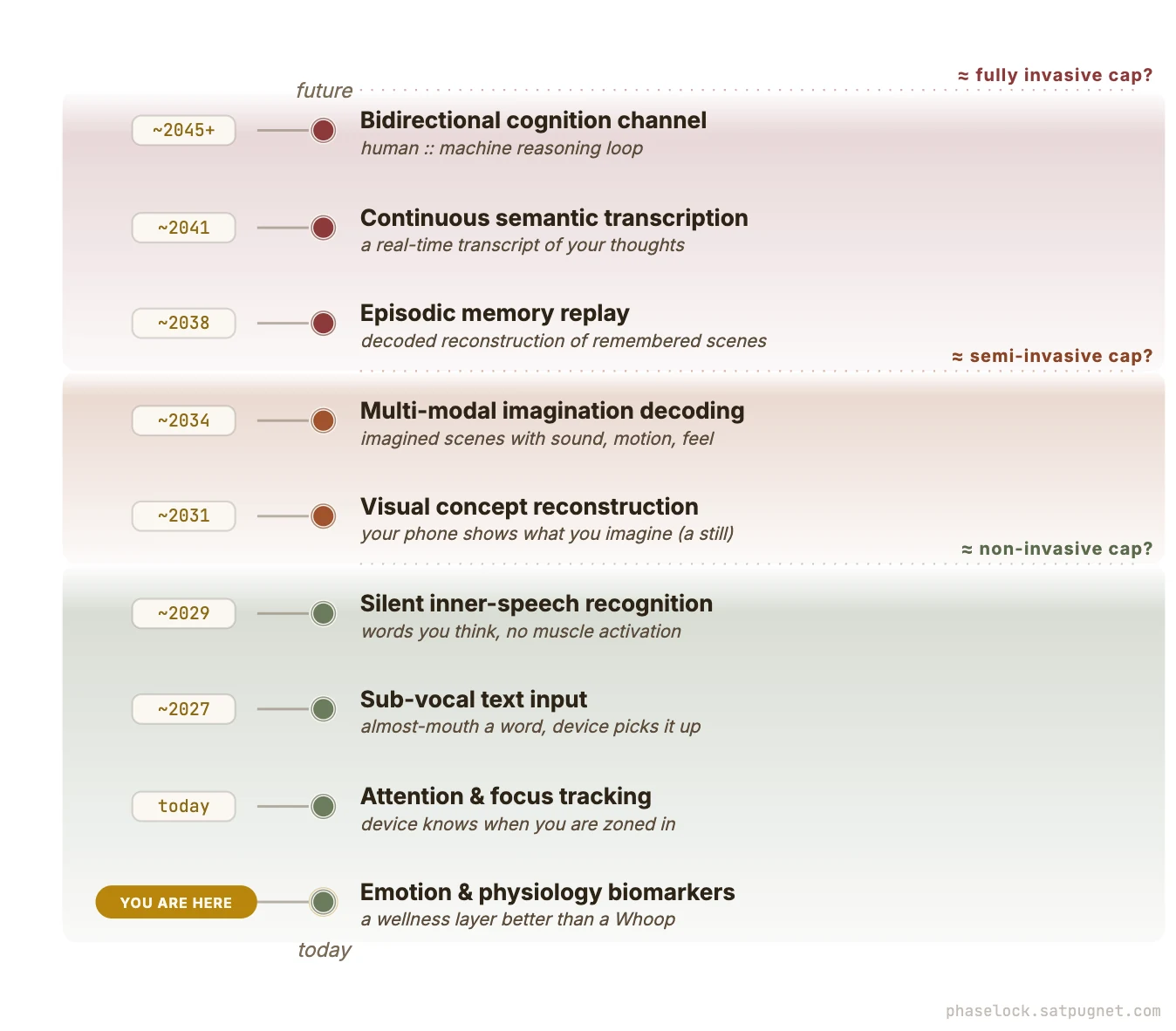 ▸, non-invasive technology has a hard, physical ceiling. The human skull is essentially a massive biological dampening armor. Trying to read or write through it makes everything a hundred times harder.
The ultimate, terminal form factor of BCI will absolutely be invasive. It will just take longer to get there.
This is the playground of companies like Neuralink, Synchron, Paradromics, Precision Neuroscience. By clearing the dura mater and placing electrodes directly on or inside the brain, the physical noise vanishes. The signal in both directions increases by orders of magnitude compared to anything that has to pass through bone.
We already know what reading at this fidelity looks like. In a landmark 2021 Stanford study, a paralyzed patient mentally “handwrote” text at 90 characters per minute simply by imagining the motor movements, all captured by an intracortical array. That is the kind of pristine, high-resolution signal you get when you remove the skull from the equation. And that is what will eventually produce the cleanest, highest-fidelity brain interface in the long term.
Invasive hardware will reach consumer scale last because neurosurgery is the ultimate regulatory and psychological bottleneck. But when it finally arrives, it will carry the absolute highest capability ceiling.48
▸.Whole Brain Emulation
Taking another step back, there is another area of neurotechnology that we have not discussed yet, but which will certainly play a major role in the future: Whole Brain Emulation.
WBE is exactly what it sounds like: the concept of emulating a biological brain directly inside a computer. While this has the distinct ring of science fiction, it is actively transitioning into a concrete engineering discipline. We have already made huge progress in digitally mapping and emulating the entire brains of animals. In late 2024, the FlyWire consortium successfully mapped the complete connectome of an adult fruit fly, detailing the exact wiring of nearly 140,000 neurons and over 50 million synapses.
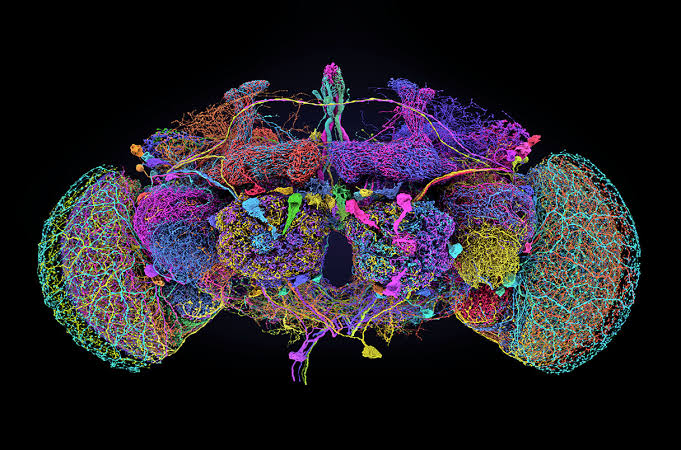
In one early demonstration, researchers took a fly’s brain data, turned it into an emulated neural circuit, placed that circuit inside a virtual fly body, and let it drive behavior. It moved without a hand-written control system, the virtual mind managed to generate movements directly from the reconstructed brain attempting to run a virtual body.
Whole brain emulation is essentially the other branch of the neurotechnology tree. Much of the capital, talent, regulatory infrastructure, and hardware flowing into BCI also accelerates WBE because the two fields share core dependencies: high-resolution neural sensing, models trained on brain data, and standardized methods for mapping the brain.
WBE is also a candidate path to artificial general intelligence. A working human emulation is, by construction, at least human-level intelligence, but with the added ability to run faster, operate in parallel, and duplicate at digital scale. Most reasonable forecasts conclude that WBE is unlikely to arrive before native AI systems achieve AGI, but the underlying economics are shifting. A recent thesis evaluating whether whole brain emulation will matter for the AI transition puts the all-in cost of a human emulation at roughly $50 billion in current scanning and compute terms.49
If non-invasive BCI scales exactly the way this manifesto argues it will, the cost of neural data acquisition and processing will plummet. As a result, the WBE timeline will compress dramatically right alongside it.50
One possible application of WBE for AI alignment would be to use it for supervision at machine speed. A sufficiently accelerated emulation could follow an AI’s actions, evaluate them against the person’s preferences, and intervene while its biological counterpart remains outside the immediate interaction. It could then report back at a pace the person can follow. This would offer a potential way to address the cognitive bottleneck described earlier.
Neural Augmentation
Looking further into the future, neurotechnology could unlock the possibility of expanding cognition itself. Neural augmentation could enhance or eventually replace parts of our biological circuitry, increasing the speed and capacity of thought. We could make the human mind itself more capable, allowing us to participate more natively in a world operating at the speed of machines.
Neural augmentation is still a long way from where we stand today, but given the trajectory of the field, I expect it to become a reality within two decades, making mind augmentation one of the key levers for long term alignment-by-integration.
At the limit of our neural sci-fi journey lies mind uploading, the possibility of recreating a person’s memories, personality, and cognitive processes in a digital substrate. A sufficiently faithful emulation could, in principle, carry aspects of who we are beyond the limits of biology. Whether it could be done while preserving the original person’s “consciousness” or whether it would create a new “conscious”51 individual remains an open question.
But let us come back to the present, where there are still countless challenges to making these visions turn into a reality. Up to this point, we have treated BCI, and neurotechnology, mostly as pure scientific and engineering equations, a matter of physics, compute, and biological ceilings. Yet, technology does not scale in a vacuum, it scales in a messy reality driven by capital, power, and state interests. Let us now turn to the geopolitical forces taking shape around BCI.
21Geopolitical Games
To fully understand how the BCI scenario will unfold, we have to step out of the lab and look at the broader chessboard. As the strategic value of the human-machine merge becomes undeniable, private markets and sovereign states are slowly taking their positions. The race for the ultimate neurotechnology is no longer just a niche scientific endeavor, it is becoming an economic and geopolitical reality.
In the past few decades, the dominance of a state, a corporation, or an economic hub has been in large part defined by its mastery over the prevailing technological paradigm. While the coming decades will undoubtedly be defined by artificial intelligence, the interfaces connecting humans to that intelligence will play just as critical a role. Some global powers are starting to recognize this emerging reality and the key role BCI will play over the coming decades.
BCI’s increased geopolitical strategic importance will develop over four main phases, with a sharp jump in interest at each step:
- The Clinical Foundation: Treating paralysis, stroke, epilepsy, and blindness. This is the bulk of BCI as of 2026.
- Productivity and Control: Hands-free computing, spatial interface navigation, silent input, and real-time cognitive workload management. The narrative shifts from medical necessity to human performance and communication with machines. This has already started and will accelerate over the coming years.
- The AI Data Engine: Neural data will reclassify from a niche biological dataset into an AI training modality, making the brain a frontier AI asset. This will become viable within a few years.
- Deep Augmentation: Closed-loop human-AI collaboration where BCI becomes the new fundamental communication layer with AI. By early next decade, this will be a reality.
Follow the Money
“Show me the incentive and I’ll show you the outcome.” — Charlie Munger
Money speaks sense in a language all nations understand, and the transition of neurotechnology from academic curiosity to a high-stakes strategic race is best captured by looking directly at the money. Private funding into neurotechnology is currently experiencing a rapid consolidation phase.
The macro jump is staggering. Global neurotech venture capital ballooned from $663 million across 127 deals in 2022 to $4.8 billion across 140 deals in 2025,52 a 7x increase in just three years.
As this ecosystem consolidates, a dominant tier of well-capitalized corporate players has emerged, holding nearly $3 billion in combined committed capital:53
- Neuralink: Valued near $9.5 billion following a massive $650 million Series E. The company has raised $1.3 billion cumulatively and rapidly scaled from a single participant to over a dozen human implants across four countries.
- Science Corporation & BrainCo: Science holds $490 million in total funding after a recent Series C. BrainCo has accumulated roughly $400 million and filed for a Hong Kong IPO at a $1.3 billion valuation.
- Synchron: Reached $345 million in total capital, placing its valuation around $1.0 billion with roughly ten active human implants.
- Paradromics: Around $120 million raised, advancing its first human trials through a strategic partnership with Saudi Arabia’s NEOM.
- The Next Wave: Merge Labs secured a $252 million round led by OpenAI to focus explicitly on semi-invasive BCI. Blackrock Neurotech was stabilized by a $200 million majority stake from Tether.
The adjacent neurotechnology stack to BCI has also grown larger in recent years: neuromodulation is already a $7 billion market, neuroprosthetics sits around $13.5 billion, and brain implants around $7 billion.54
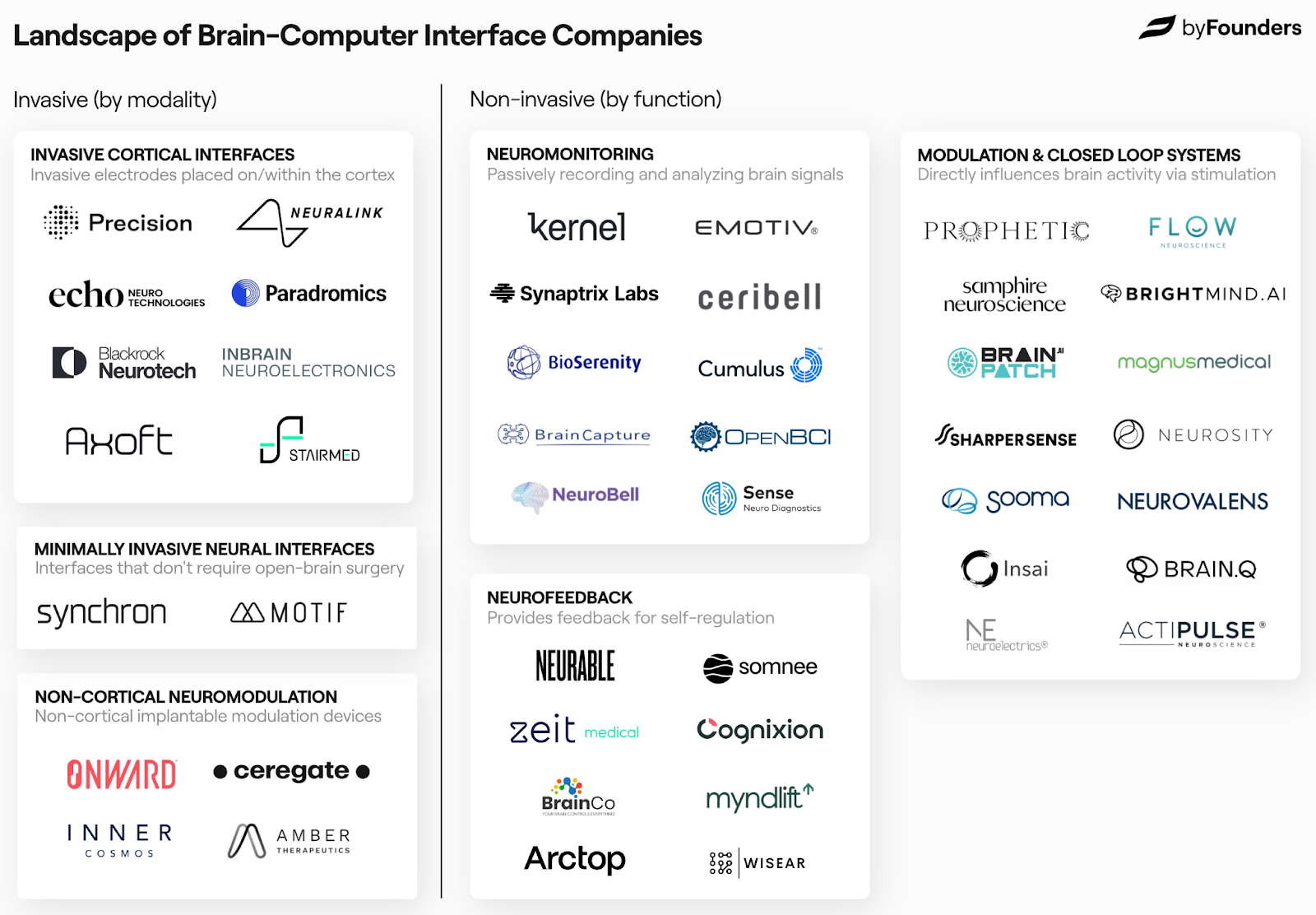
When you look past private markets and zoom out to the state level, the public funding balance reveals a broader pattern.
Western public brain-research funding is now over $4 billion. The US NIH BRAIN Initiative has deployed roughly $3.0 billion across more than 1,300 projects. Europe added €607 million through the Human Brain Project before it ended in 2023. Japan and Korea contributed roughly $330 million and $320 million respectively, while the UK is now adding around £200 million across ARIA and UK Biobank brain-imaging efforts.55
China is moving at a comparable scale. It plans on deploying a ¥100 billion (roughly $14 billion) brain-project commitment over 15 years; and has already deployed $750 million from 2021 to 2025.
Cognitive Sovereignty
The AI race has so far been a war over compute, fought through chips, fabs, and export controls. BCI opens a new front: neural data and access to human cognition. Whoever assembles the largest, highest-fidelity neural corpus will get to train the best foundation model for the brain.
The familiar dynamics we have seen with AI turning into a strategic technology will follow: concentration, sovereignty, capital, standards, and eventually export controls. But this time, the asset is not text, code, or images, it is the human mind itself. Over the coming years, governments will move more aggressively to control and dominate this new frontier.
Cognitive sovereignty will become a major issue: the question of who can collect, model, and act on signals from the nervous system. Neural data is especially sensitive because its meaning can change retroactively, a noisy EEG trace that reveals little in 2026 may expose critical information to a better model in 2032.
As a result, who owns neural data, and on whose soil it sits, will become a matter of national security. Governments will require it to be stored domestically, as several already do for genomic and health data.
The same dynamic already played out with DNA. As sequencing matured, world leaders and their security teams grew wary of leaving biological traces in hostile places, on the theory that a stray sample could later be turned into a targeted bioweapon. This paranoia escalated to the point of cleaning up after presidential visits to avoid the creation of a targeted bioweapon by adversaries (see Hacking the President’s DNA). The threat need not even materialize; the data simply gets more sensitive in hindsight, once a better technology can make use of it.
Neuroethics will also become one of the most consequential policy arenas of the coming decade. The countries that establish the first serious standards for neural data will therefore do more than protect their citizens, they will shape who can build the technology, what it can be trained on, and who ultimately controls it.
The Neural Chessboard
The main actors in the BCI race are currently the United States, China, Europe, and a few other major countries like the UK, Korea and Japan.
As of now, the US still leads the pack. A momentum partly due to Silicon Valley and partly to the US government.
On the private side, the US has the strongest startup ecosystem, the deepest venture capital markets, the frontier AI labs, the cloud infrastructure, and companies like Neuralink, Synchron, Paradromics, Precision, and others. On the public side, agencies like DARPA have funded neurotechnology for decades, especially in the awkward early phase where the science was too advanced for normal grants but too immature for the private market.
However, the US government has been less coordinated than China in recent years.
The US is already developing an export-control instinct around neurotechnology. The Congressional Research Service has flagged BCI as a potential control category.56 Similar to AI, a new battleground will open on the BCI supply chain front. It will happen across a vast array of chokepoints: sensors and electrodes, flexible bioelectronics, BCI implants, surgical robotics, biocompatible materials, neural decoding models, neural datasets, regulatory approvals, clinical trial networks, talent, and more. The geopolitical fight will not just be over who builds the best headset or implant. It will be over who controls the underlying means of production.
As things stand, the US is still the most likely country to produce the first truly powerful consumer-grade neurotech platforms. However, its fragmented regulatory environment and habit of letting private platforms become de facto governance systems make it equally likely to produce the first major neurodata scandal. That is the American model at its best and worst: incredible at creating platforms, terrible at governing them.
China has been especially deliberate recently about BCI, turning it from a scientific ambition into an operational industrial plan. In the 14th Five-Year Plan, BCI was still mostly buried inside the broader language of brain science, brain-inspired computing, and brain-computer fusion. In the 15th Five-Year Plan, it moves up a level: BCI is explicitly named as one of China’s strategic future industries, next to quantum technology, biomanufacturing, hydrogen and nuclear fusion, embodied AI, and 6G. The plan is not just to fund labs, but to subsidize the entire manufacturing base to aim for total supply chain dominance by 2030. Today, China already holds 56% of all BCI-specific patents globally, compared to 18% for the US.57
The West is losing ground; the US BRAIN Initiative has been contracting its funding while China’s Brain Project doubles down.
China is also actively forcing the demand side of the market into existence before perfect consumer products even ship. By establishing national health insurance billing codes for BCI procedures in 2025, they laid the groundwork for the world’s first commercially approved implantable BCI (Neuracle NEO) to hit the market in early 2026, beating Neuralink to the regulatory milestone.
China has shown the same pattern before in electric vehicles, batteries, drones, solar, and advanced manufacturing: once Beijing decides a technology is strategic, it can align capital, factories, standards, suppliers, and customers with unusual speed. The US still leads the BCI race today, especially through its frontier startups and AI ecosystem. But China is now moving from catching up to mobilizing the whole country.
Europe, by contrast, is playing the role of the regulatory superpower. The EU possesses strong neuroscience institutions, robust public ethics, and deep institutional trust, but a chronic inability to build dominant consumer tech platforms. Through comprehensive frameworks like the AI Act and global pushes for constitutional neurorights, Europe is actively setting the global ethical baseline for mental privacy, cognitive liberty, and freedom of thought.58 This gives Europe tremendous normative legitimacy, but not necessarily hard power. Europe is positioning itself to write the rules for neurotechnology, while inevitably importing the American and Chinese platforms those rules govern.
Defense and Dual-Use Matter
BCI is a dual-use technology.
And the US and Chinese militaries are well aware of this; they have been subsidizing the field for years in the hope that it would become mature enough to be used in warfare.
The same headset that lets a designer move faster through a spatial interface could let a drone operator control a swarm without touching a joystick. The same neural decoder that helps a paralyzed patient speak could let a soldier communicate silently in a warzone.
This is not just speculation; defense agencies have been funding neurotechnology for decades, with particular interest in human-machine teaming, soldier monitoring, rehabilitation, training, and command latency. In war, shaving seconds off the observe-orient-decide-act loop59 matters a lot.
There is already serious policy attention here. A 2025 GPPi report argues that military actors are deeply involved in US and Chinese neurotechnology ecosystems.60 The ICRC also flagged military BCI as a new international humanitarian law issue in 2025.
One of the clearest tells is the cap tables. Synchron’s 2025 round brought together traditional tech investors with the Qatar Investment Authority, Australia’s National Reconstruction Fund, and In-Q-Tel, the CIA’s venture arm. Spy agencies and sovereign wealth funds investing so intently in frontier technology usually tells a clear story which goes beyond the medical device.
Over the next few years, neurotechnology will move beyond healthcare and consumer electronics to turn into cognitive infrastructure. And just as with AI and semiconductors, any critical infrastructure technology eventually becomes a national security priority.
This is where the ethical questions become impossible to avoid. As we start altering perception, intention, attention, memory, agency, and choice; we are touching human identity at its core; and when the fundamental substrate of a technology is the human mind itself, one can easily conjure a dozen dystopian scenarios for the future. So what if things go wrong?
22Mind Reading at Scale: What Could Possibly Go Wrong
“Technology is neither good nor bad; nor is it neutral.” — Melvin Kranzberg

For as long as humans have existed, the skull has been the only truly private room in the universe. This may soon be a concept of the past.
Every technology eventually crosses a line where the question stops being “Can we build it?” and becomes “What happens if it works?”
BCI is approaching that line.
And with neurotechnology, it does not take much imagination to see how it could go wrong. BCI is not another app, another platform, or another productivity tool; it reaches into the most intimate layer of human life: the mind itself.
That is exactly what makes both the upside and the risks so enormous.
Like AI risk, the risks of neurotechnology are poorly understood, and for most people the best mental models they have come from science fiction. Given the breadth of the topic, a serious treatment would be a manifesto of its own,61 we will therefore only be scratching the surface here.
The Neurotech Risk Surface
The risks below are ordered by expanding blast radius; from what neural interfaces can reveal and manipulate within an individual mind, to their effects on identity, society, and ultimately the trajectory of AI:
Mental privacy. Neural data is a leaky signal: it can reveal more than the user intends. As decoders improve, a neural signal that today tells you whether someone is thirsty can later be used to infer depression risk, political leanings, attraction, addiction vulnerability, or job performance. Harmless data today can become intimate data tomorrow, and once collected, it is hard to take back.
Manipulation. Once BCIs mature, they will stop being passive sensors and writing will become possible. They will be able to recommend, nudge, stimulate, suppress, or amplify thoughts and emotions. The main failure mode becomes not only malicious actors hacking your thoughts, but also your attention, mood, and choices being gradually mediated by a system optimizing for something you did not choose, with access to your raw cognitive machinery. We have run a version of this experiment before, with recommendation algorithms on social media restructuring public discourse while holding nothing but your click history. Give those same algorithms the error signal straight from your limbic system, and the result could be dangerously superhuman persuasion.
Identity drift. A BCI that augments someone can also create dependency, dissociation, and over-trust in machine output. With a closed-loop AI operating this close to the mind, identity itself blurs. Did I choose that, or did the model predict and complete me? Did the stimulation improve my mood, or alter my preferences? Am I becoming more myself, or more optimized? These questions have no clean answers, and the drift they describe will be hard to control.
Regulatory lag. Regulation is nowhere near ready, and the ceiling problem makes it worse: when you do not know what a technology will eventually decode, the rules have to cover the extreme futures, not just the current demos. If a few minutes of EEG could one day reveal whether someone committed tax fraud, is it acceptable for that data to sit in a training corpus today? Consent has a time-machine problem: you find out what you gave away only after the models improve. Genomics already screened this movie, 23andMe’s bankruptcy turned the DNA of 15 million people into an asset for sale.62 Consumer neurotech is currently worse, in an audit of 30 companies, 29 granted themselves effectively unrestricted access to neural data, nearly all reserved the right to transfer it, only one in five even mentions encryption, and exactly one rules out sharing it altogether.63 Meanwhile the deepest questions have no case law at all. For instance: if a BCI logs your P30064 recognition response to a crime scene photo, can it be subpoenaed? Does the Fifth Amendment cover a brainwave?65
2026. You wore a $99 headband to sleep and focus better, and agreed to one thing: let it score your focus.
Re-read by 2026
Re-read by 2030
Re-read by 2035
Structural tension in society. Human society has run for millennia on the assumption that thoughts are private. Courts, marriages, negotiations, elections: all of them depend on the fact that no one can check what you really think. AI already challenged our monopoly on intelligence, sending ripples and fractures through society. BCI is about to challenge the privacy of the mind. If that shift arrives faster than society can rebuild itself around the new reality, the damage could be severe. There is also the risk of cognitive inequality and concentration of power: whoever controls the brain-and-AI stack controls the interface to intelligence itself, which could widen the gap between social classes, age groups, and countries.
Brain hacking. As strange as it sounds, everything connected can be attacked, and a read-and-write brain device would be the most intimate attack surface ever shipped. The threat model is ordinary cybersecurity with new stakes: signal interception, spoofed inputs, malicious neuromodulation, denial of service. A ransomware would feel differently if what it encrypts were your ability to think clearly. Every security failure of the last 30 years can be replayed here, against a piece of hardware you cannot uninstall.
The surveillance state. Every surveillance technology has followed the same trajectory: smaller, cheaper, easier to hide, every year. Cameras and microphones did it; neural sensors will too. In the wrong hands that means emotional surveillance, dissident profiling, interrogation, and eventually thought decoded at population scale. The polygraph66 was junk science and still got a century of use; now imagine a version that actually works, deployed at scale by an authoritarian state.
The AI-safety backfire. On the AI side, the sharpest risk is that neurotechnology does not help with alignment at all and only augments AI capabilities. Humanity’s inner life becomes one more pretraining corpus while the technology grows ever harder to control. And even if BCI does help steer and align AI, there is a risk that we align it on a subset of minds not representative of humanity. Lastly, if neural data becomes as valuable as we expect, predatory behaviors may emerge to collect it at scale.
The meta-risk. Underneath all of these sits something larger: the risk that humanity is simply not ready for this shift of its reality. We may end up governing twenty-first-century access to the mind with twentieth-century categories, because those are the only ones we have. AI was the first blow to human identity; BCI is the second, and it raises the question directly. What is a human being when the boundaries of the mind are negotiable? What is the self? What is our role in the world that follows? None of these questions will be easy to answer.
Neurotechnology will force some of the most profound questions humanity has ever had to answer, on the timeline of a product cycle.
How This Goes Right
So if the risk surface is this large, why build BCI so fast?
The honest answer is that, were AI capabilities not growing exponentially, I would advocate for slowing down the development of neurotechnology to give us more time to get it right. But as the world stands, building BCI has now become a necessity. The age of machines is upon us, and BCI is one of the few technologies with a real chance of making that transition survivable for humanity, one of the few chances we have to do alignment-by-integration. At this point it is not just an aspirational techno-utopian dream, it is becoming existential.
Building it right will be extraordinarily hard, as every scenario above should have made clear. But it is doable, good outcomes are possible; they simply have to be treated as an active design problem rather than the default outcome. And because we still only half understand the technology, the frameworks we build around it have to evolve dynamically.
We should start with architecture, because the strongest guardrails are not legal but technical. Raw neural data should leave the device as rarely as possible: process locally, transmit intent rather than brainwaves, export features rather than raw traces, train through federated learning and differential privacy so models improve without the signal ever pooling on anyone’s server. Where large corpora are genuinely needed, they can live in independent data trusts that audit and license access, rather than letting any single platform accumulate humanity’s inner life. A law can be repealed by the next administration; but an architecture has to be re-engineered. Privacy enforced by physics is the only kind that survives a bad decade.
We have already worked miracles with the internet and with biotechnology, we can pull it off once more.
The same logic applies to business models. Social media did not become an outrage machine because its engineers were malicious; it became one because advertising was the revenue model and attention was the product. The cheapest way to avoid replaying that mistake at the neural layer is a bright line: brain data and advertising must never meet.
Consent has to grow up too. A checkbox at install cannot govern a data stream whose meaning changes as models improve. Neural consent needs to be granular, auditable, revocable, and, above all, perishable: it should expire unless renewed, because next year’s models will read what this year’s cannot. That is the answer to the time-machine problem. If you cannot take back what you streamed, then streaming has to become a running conversation rather than a one-time signature.
The law, for its part, needs one conceptual upgrade more than it needs a thousand new pages: neural data is not app data, not wearable data, not even ordinary biometric data. It deserves its own category at the very top of the sensitivity hierarchy, with strict purpose limitation, no resale, no secondary inference (the focus tracker that covertly scores your politics should be illegal, not just creepy), no employer or insurer access by default, robust deletion rights, and hard limits on what can be trained from it. Above all, cognitive liberty, the right to mental self-determination, must be recognized as a fundamental right rather than a nice idea in an ethics paper.
And here, unusually, there is good news. Chile wrote neurorights into its constitution in 2021. Colorado, California, Montana, and Connecticut have extended their data-privacy laws to neural data, and their definitions are becoming the de facto American standard. UNESCO’s Recommendation on the Ethics of Neurotechnology, adopted by its member states in November 2025, is the first global normative instrument for the field: soft law, but a shared vocabulary. The EU AI Act’s guidance already cites brain-computer interfaces by name in its rules on prohibited manipulation. In roughly two years, neural data has gone from no specific protection anywhere to binding or near-binding coverage for some 50 million people. Regulation usually arrives years after the scandal, for once, it has a chance of arriving before.
Two lines deserve to be drawn thicker than all the others. First, the write channel is sacred. Reading the brain is dangerous; writing to it is civilization-level dangerous, and the standards should treat it accordingly: the closer a system comes to changing a mental state, the higher its burden of proof should be. Second, the brain must be treated as critical infrastructure: threat-modeled, red-teamed, secure by default, and protected internationally by red lines drawn before escalation rather than after. No neural interrogation. No compulsory brain monitoring. No covert neuromodulation. And no neuroweapons. Humanity eventually built such norms for biological and chemical weapons; this time we could build them before the first use instead of after it.
There is also a failure mode on the other side though, if we regulate this field into the ground, we will not get more safety; we will freeze BCI precisely during the decades when it matters most for navigating the transition to advanced AI. And in addition this hands the frontier to whoever does not ask permission. The goal is not to be slow, it is to be deliberate about how we build the technology. We have to move fast but intentionally: humanity’s future is at stake, we cannot afford to pause here, and we cannot afford to get it wrong.
Alongside all of this, we need to raise public literacy. Just as AI did, neurotechnology is about to enter the global conversation, and it should be something people actually understand. A society with an accurate mental model of what these devices can and cannot do is better equipped to choose well, it also becomes harder to panic, and harder to lull.
Kranzberg’s law67 is usually quoted as a warning. This technology will not be good on its own, and it does not have to be bad. It will be exactly as good as the standards we set while it is still young enough to accept them, and that work is needed right now.
Ultimately, if neurotech treats neural data the way ad-tech treats browsing data, it deserves to fail. Every guardrail in this section, the architecture, the consent, the law, the red lines, should exist to keep the technology on the right side of history.
And beneath all the policy sits a choice no regulator can make for us: deciding what we want to preserve about being human. Is it agency? Authenticity? Intelligence? Mental self-determination? The privacy of an inner life? We should name those things deliberately and design toward them, or they will be defined for us.
BCI has the potential to help humanity keep its hands on the wheel as AI grows ever more powerful, while unlocking countless other capabilities along the way, all through a technology we could barely dream of a decade ago. But it is also one of the most dangerous technologies humanity has ever brought within reach, and it should be treated accordingly.
Let us now turn to what the coming decade could look like if we make the right choices.
So far, I have worn the hat of the cautiously optimistic futurist, mapping the most plausible path forward, but any serious thesis must survive its strongest objections. So let us swap hats: if this vision hits a wall, where will it happen, and what could derail it?
23The Case Against the Case
“I am not entitled to have an opinion unless I can state the arguments against my position better than the people who are in the opposition.” — Charlie Munger
There is no shortage of reasonable objections to this thesis, ranging from the physics of the human skull to the information theory of foundation models and the basic economics of hardware scaling. To earn the right to be taken seriously, I cannot just swat at strawmen; I have to face the strongest objections head-on.
Here are the 13 objections that should be addressed.
01.Non-invasive may have a fundamental signal ceiling that scaling cannot break.
The skull blurs and attenuates neural activity, leaving a noisy, underdetermined signal. Scaling can extract hidden structure, but it cannot recover information that physics has erased.
ResponseWe do not know where that ceiling sits. This is ultimately an empirical question, and the field has not yet scaled hardware, data, and models far enough to answer it.
02.Non-invasive research may divert resources from the higher-potential invasive path.
Capital, talent, and institutional attention are finite. If invasive systems have a much higher capability ceiling, directing the field toward easier-to-market headsets could delay the path with the greatest long-term potential.
ResponseThat argument made more sense in 2015 than it does in 2026. Hardware advances, data standards, decoder architectures, and clinical infrastructure increasingly transfer across modalities. Capital and talent drawn into non-invasive BCI strengthen the broader field, even if invasive ultimately wins. More importantly, for the foreseeable future, non-invasive is the only path with a realistic chance of escaping the lab and reaching millions of people.
03.The brain may not be the same kind of scaling problem as the internet.
Brain data is noisier, more individual, and structured across many time scales; its labels are also far weaker. The Bitter Lesson may not transfer cleanly.
ResponseAs with the signal ceiling, this is a question only scale can settle. So far, the evidence points in the right direction: ZuCo, DEAP, AllJoined, BrainLMBrainLM: A foundation model for brain activity recordingsA 90M-parameter transformer pre-trained on 6,700 hours of fMRI from 40,000+ subjects. The first serious foundation model on neural recordings; the existence proof that scaling laws show up on brain data the way they show up on text.▸, and Banville et al. all show performance improving with more neural data across multiple modalities. ENIGMAENIGMA: a parameter-efficient EEG-to-image decoderState-of-the-art EEG-to-image decoding with under 1% the parameters of prior baselines and a 15-minute new-subject calibration. Trained on Alljoined-1.6M (consumer-grade) and THINGS-EEG2 (research-grade).▸ reached state-of-the-art EEG image decoding on both consumer and research-grade hardware, using under 1% of the parameters of prior systems and only 15 minutes of calibration for a new subject. There is early evidence, not just aspirational hopes.
04.BCI may lack the universal self-supervised68 objective that made AI scaling work.
Language modeling scaled because predict-the-next-token is stupidly universal: every paragraph on the internet is a labeled training example for free. Brain decoding has no such clean objective; most current approaches train task-specific decoders that do not transfer.
ResponseThe shape of the emerging objective is starting to look like multimodal world-brain prediction. Given a neural signal plus context (eye movement, audio, behavior, task state, screen content, body pose), learn the latent representation that predicts the missing channel. Less elegant than next-token prediction, but not obviously less scalable; indeed, AI has since scaled successfully on messier objectives, from masked-image modeling to contrastive learning across images and text. And the unit of training data, “brain signal plus context”, is exactly what consumer hardware will produce by default.
05.Subject variability may kill foundation-model economics.
Brains differ in anatomy, plasticity, and biochemistry. A decoder trained on one person rarely transfers cleanly to another.
ResponseThis is the core bet Section 10 Section 10Level Three: Foundation Models for the BrainPart II · The Scaling: Does the AI scaling playbook work on the brain?▸ traces in detail: that pretraining across many brains collapses the marginal cost of decoding a new one. If pretraining works for brains the way it works for language and vision, personalization becomes a short calibration step rather than a bespoke training process.
06.BCI has no parallel consumer market subsidizing its manufacturing iteration.
Modern AI scaling was carried for over a decade by adjacent multi-billion-dollar markets that drove the underlying silicon, such as video games and crypto. They paid for the Nvidia GPU R&D that AI eventually needed.
ResponseThe world is a densely connected graph. As a result, much of the hardware BCI will require is already being subsidized by adjacent industries: smartphone sensors, consumer-health wearables, mature CMOS, cheap optics, AR/VR, and decades of declining sensor costs. This is also going to be greatly amplified by the incoming rise of robotics. Some genuinely new technology will still be required, but most of the stack can be assembled from increasingly capable off-the-shelf hardware.
07.The consumer-EEG graveyard.
Muse, Emotiv, NextMind, CTRL-labs, a handful of others: the last consumer non-invasive wave produced demos, acquisitions, and shutdowns, not a sustained product category.
ResponseThe earlier wave tried to build products before the underlying stack was ready. There were no foundation models for the brain, no multi-modal sensor stacks, no shared protocols, no AI labs hungry for data, no cheap consumer-grade sensors. Just like most technologies, it does not work until it does; it is all about timing. The case today is not simply that “this time is different”, but that several missing pieces now exist.
08.Neural data may not be valuable enough to frontier AI labs.
Labs already have enormous text and video corpora and are increasingly relying on synthetic data, reinforcement learning, and simulated environments. Noisy, expensive, consent-sensitive neural data may add too little marginal information to justify significant investment.
ResponseNeural data is potentially valuable because it captures aspects of cognition that text, video, and synthetic data can only expose indirectly: raw information processing from the brain. That could improve both capability and alignment (Section 17 Section 17The New Major Training ModalityPart III · The Collision: Why does BCI matter for AI?▸, Section 19Section 19Why This Matters for AI AlignmentPart III · The Collision: Why does BCI matter for AI?▸). And as frontier labs approach the data wall and alignment becomes increasingly central, genuinely new modalities with a chance to address those issues become more valuable. But this remains an empirical bet: labs will need to test whether neural data produces measurable gains on capability and alignment.
09.Neural data may be too private, too regulated, or too socially radioactive to become a frontier training modality.
People accept watches that log sleep and heart rate. They may feel differently about a device tracking attention, recognition, or emotional state. One sufficiently ugly scandal could set the field back years.
ResponseExactly why on-device preprocessing, differential privacy, and institutional legitimacy have to be designed into the technology from the start. The wrong version of this future would be extractive, opaque, and dangerous; the right one would be opt-in, auditable, and clearly valuable to the person generating the data. Once again, if the field treats neural data like ad-tech data, it deserves to fail.
10.The real human bottleneck may be comprehension, not communication bandwidth.
A faster pipe does not make the biological brain faster at understanding, judging, or verifying superhuman reasoning. A thousand-fold increase in input bandwidth could simply become a firehose into a bathtub. If comprehension is the binding constraint, BCI tweaks the wrong knob.
ResponseIn the near term, BCIs will increase the practical bandwidth between humans and machines by: reducing the meaning lost in translation, enabling AI to adapt explanations to a user’s understanding in real time, and operating at the right level of abstraction rather than dumping raw reasoning into the mind. However, fundamentally, communication bandwidth will not increase human thinking and processing speed; and as AI’s thinking speed accelerates, BCI alone will not allow the biological brain to keep pace with AI. This manifesto’s claim is that BCI will only be the first step towards closing this gap, it will catalyze advances across neurotechnology that will then collectively help close the human-machine gap. As the mind’s bottleneckThe mind’s bottleneck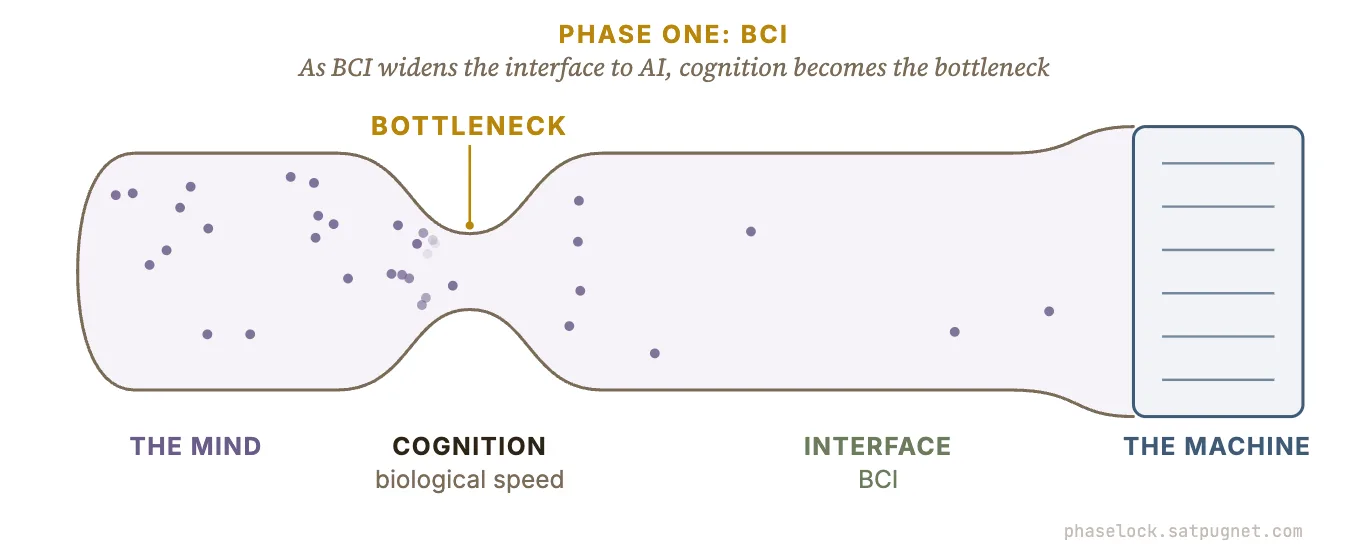 ▸ illustrates, communication bandwidth is only one of two bottlenecks, and it will be the first and most tractable one to address. Nevertheless, over a longer time horizon, neurotechnology will also offer a path to addressing the second bottleneck: cognitive speed; through neural augmentation and brain emulation, we will have a path to overcome the biological limits of cognition itself.
11.A better human-machine interface does not solve alignment on its own.
At best, it improves how clearly humans can express intent, preference, and correction. But alignment is ultimately about what the system is optimizing for, and a more capable interface may be only tangential to that problem. A misaligned system does not become safe simply because it can understand us better.
ResponseA better interface is not the complete alignment solution, but it is nonetheless a significant part of it. Neurotechnology could improve reinforcement learning, provide richer signals of human intent and preference, surface confusion or disagreement, and overall help train models that better understand conflicting and complex human values (see Section 19Section 19Why This Matters for AI AlignmentPart III · The Collision: Why does BCI matter for AI?▸). BCI, and neurotechnology more generally, is one of the only technologies with a real shot at enabling alignment-by-integration before the Phase Lock Window closes, its development should therefore be prioritized accordingly.
12.A neural interface may strengthen the machine more than the human.
The AI could use access to attention, emotion, uncertainty, and preference to model us with extraordinary precision, while our ability to understand or supervise it improves only marginally. The same channel meant to preserve human control could instead become a powerful tool for persuasion and manipulation.
ResponseThis is a real danger. Better access to the human mind can improve oversight, but it can also make AI persuasion far more potent. The solution is to not assume neurotechnology will naturally favor the human; but instead to be intentional in our development and design of the technology to mitigate those risks.
13.Neural feedback may optimize for impulses rather than values.
Fast neural reactions are not the same as reflective preferences. They contain novelty, fear, arousal, bias, addiction, and immediate reward. Treating them as biological ground truth could turn RLHF’s existing failure modes into something much stronger: models optimized not for what humans endorse, but for what most effectively lights up the human reward system.
ResponseNeural signals should indeed not be treated as unquestionable ground truth for training, their value is as one signal among many. Used carefully, they may help detect confusion, error, or hidden disagreement; used naively as a reward target, they become another Goodhart’s failure69, optimizing for stimulation rather than human values. The solution here is to remain mindful of the way we make AI ingest this new signal.
We are currently navigating treacherous waters. Blindly following a roadmap drafted with information from 2026 is a recipe for disaster. The map is not the territory, and any attempt to project decades of technological evolution is fundamentally an exercise in probabilistic estimation, offering a set of strong priors that must be ruthlessly updated as empirical reality delivers new data. As the neurotechnology landscape matures and the fog clears, we must remain relentlessly willing to re-assess our trajectory and critically question whether neurotechnology remains a net-positive technology to continue developing.
Neurotechnologies are not a panacea. Even a flawless, zero-latency system capable of reading and writing a human mind with perfect fidelity still leaves us with an immense, daunting mountain of alignment, ethical, and architectural problems to solve. It is only one piece of a vastly larger puzzle.
However, if we ground ourselves in first principles and project out into the long-term horizon, say the year 2060, BCI will be a prerequisite for humanity to remain consequential. Once machines operate at a scale a million times more capable than biological humanity, able to execute, reason, and iterate better than us in every conceivable domain, establishing a robust, high-bandwidth control and interaction surface will be an absolute necessity.
24The Decade Ahead
“The future is already here; it’s just not very evenly distributed.” — William Gibson
We tend to look at humanity’s greatest achievements as singular, explosive events: the day the bomb dropped, the day the internet turned on, the day the first LLM went viral. But hindsight is a terrible historian, always eager to dramatize and compress events. In reality, deep technological shifts happen more like water freezing: a long, invisible drop in temperature, then the first sudden slush, and then a thousand small crystals locking into place until, seemingly all at once, the ground beneath you is solid ice.
The next ten years of neurotech will follow the same narrative, the same one we just witnessed with language models: a long quiet under-the-radar phase, then sudden visibility, followed by ubiquity, and finally the strangeness that comes with a new world order.
We now turn to the future. The next ten years will likely be the most transformative in human history. AI will give machines intelligence, robotics will give them bodies, and BCI will begin connecting them directly to the human mind. The Old World is still standing, but the scaffolding of the new one is already everywhere.
2026–2028: First slowly
The next 24 months will look the way 2018 to 2020 looked in AI from the inside. Calm, but accelerating.
The first usable foundation models for brain decoding will ship publicly, trained on EEG, ultrasound or MEG. Frontier AI labs will start exploring the use of neural data. At the same time, the first generation of non-invasive consumer devices a healthy adult would actually choose to wear will begin shipping at scale, somewhere between sub-vocal text decoding and continuous attention monitoring.
BCI will leave its purely academic, medical niche and start bleeding into the broader culture. You hear friends bring it up at dinner, a high-production documentary drops, a YouTube deep-dive goes viral. It will stop feeling like a sci-fi trope and start feeling more like an impending reality.
As the tech matures, impressive lab results begin to stack up. Teams demonstrate the ability to decode complex language, reconstruct visual images from the visual cortex, and map fine-grained user preferences directly from neural signals. This compounding momentum changes how capital and talent move, top-tier software engineers and AI researchers who were entirely focused on LLMs start pivoting their careers toward the human machine interface.
The gravitational pull of BCI is growing.
Crucially, this technology accelerates a shift that AI already started, the human role continues to drift away from being an operator, and toward being a source of judgment, taste, priority, and intent.
By early 2028, a frontier AI lab will announce a neural-data partnership, explicitly framing it as a training modality or alignment investment. Shortly after, the first landmark peer-reviewed paper will drop, showing that brain-tuning data directly improves a flagship model’s reasoning or alignment metrics.
By the end of 2028, the calm phase ends. It will become blindingly obvious to anyone paying attention that BCI is moving much faster than the public consensus expected. The dam will begin to break.
2028–2031: And then suddenly
The late 2020s and early 2030s will look the way 2022 to 2025 looked in AI. Loud.
The first BCI primitive will hit 10 million active users. Sub-vocal text will begin displacing voice commands and physical typing for short interactions. Some people will start reading mail, sending messages, and dictating notes entirely in their heads, the same way mobile typing displaced laptop typing a decade earlier. BCI will also become a more central tool for alignment, and the first peer-reviewed demonstrations that brain-tuning improves frontier-model metrics on standardized benchmarks will happen around 2028 or 2029. This is the era where people stop calling neurotechnology an “emerging” field. By 2031, BCI will hit its Tesla moment: a flagship consumer product that the general public can name will appear, making the technology mainstream.
As this transition happens, the hardware will iteratively vanish from daily life. The form factor will shrink into earbuds, a beanie, the temples of AR glasses, a hat or a simple woven headband. It becomes wearable all day, practically invisible, and socially acceptable.
BCI will start embedding itself deeper into the social fabric. People begin using it more regularly at work and in social settings. It shows up more often in movies, comes up more often in politics, and public figures start talking about it.
As BCI improves, it shifts from decoding coarse commands to decoding fine-grained intent. You no longer have to formulate a sentence to trigger an action, it becomes possible to interact with AI using only your thoughts, and starts to become more effective than typing or speaking. Thought-to-text and thought-to-speech become familiar concepts inside AI labs, and “how do we make LLMs easier to interface with through the brain?” becomes a hot topic.
This unlocks capabilities that sound genuinely absurd by today’s standards. You think of a query, and your earbuds whisper the answer back. You beam a raw concept or a melody directly to a friend’s headset. You record memories, dreams or thoughts and play them back as images or videos. And with the rise of embodied AI and robotics you can even look at a domestic robot, think about a task, and watch the machine execute it with near zero friction.
At this stage, a reasonable number of knowledge workers will have tried a non-invasive headset, much like VR today, except this time the technology actually works. Once people can touch it, wear it, and feel the interaction for themselves, the technology becomes tangible, shifting the public conversation from metaphysical speculation to an immediate reality. The public conversation will get more vivid overnight.
Simultaneously, the invasive side of the market will mature rapidly. Implants will scale from hundreds of clinical-trial patients to tens of thousands of medical users, nearing a hundred thousand by 2031.
Crucially, for invasive BCI, the delivery mechanisms will become far less barbaric as the field begins moving beyond the “skull drill”70. The industry will start moving away from open-brain surgery toward minimally invasive delivery. Companies like Synchron will deploy stents up the jugular vein71 to read the motor cortex from the inside of a blood vessel, avoiding the skull entirely. Competitors like Neuralink will advance techniques that avoid piercing the dura mater72, while others push toward flexible bioelectronics and injectable neural dust: tiny implanted sensors designed to record neural activity with less surgical trauma.73
These years won’t just be about surreal technology; they will also be ruthlessly competitive. BCI will transition from a fun gadget to an economically necessary tool, and governments, massive corporations, and institutional capital will race to secure position. As the stakes rise, mental privacy will become a mainstream political fight, showing up on social media, in regulation, and in arguments at home. Neurorights will become normal policy language.
By 2029, cumulative venture funding in BCI will cross the $8 to $10 billion mark. Sub-vocal text will become a viable input for AI glasses, and the first wave of non-invasive consumer products will begin shipping at scale.
By 2030, the industry will cross the 10-million shipped units threshold. This milestone triggers the arrival of a US federal neural-data framework with actual enforcement teeth, alongside the first frontier AI model cards explicitly disclosing neural data in their training mix.
That same year, the medical sector will hit 10,000 active invasive BCI implants globally, demonstrating the safety and scalability of surgical deployments.
By 2031, the true Tesla moment arrives. Cognitive-state-aware AI assistants are firmly on a path to become the dominant, default interface to machines, permanently changing how humans interact with digital infrastructure, setting humanity on a path toward a full merge by the 2040s.

2031–2036: Ubiquity
By the early 2030s, BCI crosses the threshold into true ubiquity, it is no longer a technology you have to explain or justify. Everyone has an opinion on it, everyone sees its footprint on society, and the initial debate over whether it is real dissolves entirely.
The most profound shift of this era is the evolution from prompting an AI to thinking with an AI. Collaboration turns into symbiosis, the days of pulling out a phone to type a query start to look ancient. Instead, the AI runs as a continuous background process alongside your mind. The boundary between your biological memory and the machine’s data retrieval begins to blur.
This creates a true cognitive exoskeleton. Just as the smartphone turned humanity into a primitive, high-latency cyborg network in the 2010s, AI and BCI create a low-latency, always-on exocortex. It amplifies human capability at a deeper, more structural level than any screen ever could.
This transformation does not hit everyone at once. The future remains unevenly distributed, and a large portion of the population continues to work and live using the baseline tools of the mid-2020s. But for an ever-increasing, hyper-productive segment of the global workforce, operating without this cognitive layer feels like trying to run a modern business without electricity.
At the same time, computing transitions from episodic to ambient. The headset or implant reads your cognitive state continuously, not just when you consciously issue a command. AI agents monitor your cognitive load, attention levels, and mental fatigue in real time. If a complex technical task spikes your stress, the system can automatically dial back distractions, curate your digital layout, and surface the exact reference material you need before you even realize you are stuck. Prompting becomes a relic of the early AI era; ambient computing becomes the new default.
This is also the moment where the “write” side of neurotech starts picking up real commercial momentum. Up until now, the field was heavily dominated by high-fidelity reading. By the middle of the decade, precision neuromodulation procedures begin moving into the consumer mainstream, becoming as harmless as LASIK surgery. It is now possible to write precise thoughts and feelings to the brain. By 2037, the first augmented adults will think measurably faster than their own unaugmented selves.
Ultimately, the early 2030s is the point where four massive, independent technologies collide. High-bandwidth non-invasive BCI, frontier artificial intelligence, large-scale humanoid robotics, and early brain-writing capabilities. All at once, they stop being separate industries. They fuse into a single, compounding tech stack. Mirroring the way smartphones, the cloud, mobile broadband, and app stores combined in the early 2010s to create the modern digital world.
Over time, read becomes read-and-write, industrial and humanoid robotics systems adopt BCI as their natural control interface, the bandwidth bottleneck between human intent and machine execution closes in earnest, and the broader AI alignment problem makes significant progress, in large part thanks to advances in neurotechnology.
By 2032, direct robotic control through BCI becomes a highly credible, multi-billion-dollar enterprise category. The same year, the first heavily capitalized neurotech conglomerate begins offering fully bidirectional, consumer-grade read-and-write systems designed specifically for healthy adults.
The gravitational pull of BCI is now second only to a few technologies; alongside AI and robotics, it redefines how the world operates.
2036 onwards: The strange phase
After 2036, the timeline loses its linear feel. We cross a civilizational horizon where the boundary between human and machine disappears.
The catalyst is the Write revolution. For 20 years, neurotech was nearly exclusively about listening to the brain. Now, we talk back. The industry figures out how to insert rich sensory data, structured concepts, and motor skills directly into the cortex. The Matrix skill upload74 transitions from a sci-fi trope to an emerging feature of reality.
On a daily basis, this manifests as a fully programmable state of mind. You gain granular control over your own neurochemistry. You tap a screen, or just issue an internal intent, to induce instant, restorative sleep, mute an adrenaline spike before a presentation, or lock into a flawless four-hour hyper-focus state without pharmaceuticals.
But as the technical barriers fall, the philosophical ones become existential. When you can rewrite a mental state at will, the concept of the self fractures. If a machine can dial down your anxiety or inject a memory, where do the boundaries of your original identity end? Humanity is forced to invent entirely new legal and moral categories as the mind is no longer an unmappable black box.
We are now navigating dangerous, uncharted territories.
This convergence enables true proto-telepathy. For millennia, human collaboration has been bottlenecked by language, an incredibly low-bandwidth, lossy compression format for thought.

With bidirectional communication, we unlock conceptual sharing. Instead of spending an hour translating a complex spatial map or nuanced feeling into words, you transmit the raw, multi-dimensional concept directly to a collaborator’s mind. They do not just hear your explanation; they grasp the mental model exactly as it exists in your head.
For better or worse, emotions themselves become transmissible, and real-time transmission of emotional states challenges the very nature of human isolation. When you can feel the precise texture of another person’s grief or fear, human conflict and relationship dynamics undergo a brutal structural rewrite.
As the years roll forward, the loop between mind and machine tightens into a complete symbiosis. The baseline definition of the impossible keeps shifting, leaving the twentieth-century world feeling like a distant memory.
Maya in 2038
Maya wakes up. The subtle neural node behind her ear already knows she slept poorly; her morning agent has rescheduled her 9:00 AM meeting before she has even opened her eyes. She forms the internal intent for coffee, and the kitchen downstairs hums to life.
The first hour of work used to be emails. Now it is an unvoiced conversation. She thinks toward her assistant, the assistant thinks back, and the rhythm of the exchange runs at the speed of inner thought. The decoding model does not read the words she would have typed, but the raw, uncompressed shape of what she thinks.
When her attention drifts toward a lingering problem from yesterday, the assistant seamlessly surfaces the relevant context without being asked. When a drafted response from the AI is slightly off, Maya’s recognition of the wrongness reaches the feedback loop milliseconds before her physical hands could ever move. She corrects the model in real time, without ever articulating the correction.
When she needs to recall a specific metric or look up a complex financial projection, she does not feel like she is searching an external database. She simply feels like she suddenly remembers the answer, it is seamlessly injected into her mind. The boundary between “a human thought” and “a machine thought” within any given reasoning has blurred.
By lunchtime, Maya has cleared a volume of creative and analytical work that, in 2026, would have taken her more than a week. But it does not feel special at all, it just feels like a normal Tuesday.
The infrastructure that made all of this ordinary arrived in increments. For years, the typical knowledge worker wore a non-invasive headset every single day. By 2035, the surgical and regulatory floor for elective, low-risk neural modules dropped to where laser eye surgery sat a decade earlier. What began as medical restoration for late-stage ALS and Parkinson’s patients slowly became a standard surgical upgrade. Maya got hers last year, right after her close friend did.
Now, she no longer remembers what it felt like to have to compress every thought through her thumbs. The small, bidirectional module interfacing directly with her cortex is now an inherent part of her life and her self. It even helps with memory consolidation overnight; she sleeps deeper and dreams more vividly.
Late in the afternoon, Maya steps away from her digital flow to paint. She picked up the hobby recently, though the learning process looked nothing like it would have a decade ago. She did not spend months failing at perspective or color theory. Instead, she acquired the foundational muscle memory and spatial understanding directly through her neural node. As she waits for a layer of oil to dry, her mind drifts to a dense philosophy book on visual aesthetics. She never actually sat down to read it, she simply accepted the conceptual transfer over the weekend, and by morning, the arguments were entirely legible to her. As she blends a shadow on the canvas, she casually executes a technique she never consciously practiced, guided by the vivid memory of a text she never opened.
Sitting back, Maya spots a scattering of cups and streamers in the garden from her children’s birthday party yesterday. With a fleeting pulse of intent, she directs a small fleet of domestic robots to clear the lawn. The machines glide into motion as she slips seamlessly back into her afternoon flow, lost in her own thoughts.
Later, she enters the design phase of a new architectural project; she needs to finish the first iteration by tonight. She does not write code or draft blueprints, software and structure have stopped being typed; they are simply imagined into existence. She envisions the layout, materiality, and light of a new building with the fluid, intuitive ease of a child building in Minecraft75.
By early evening, when her partner walks into the room, Maya does not need to ask how his day went. She can literally feel it; she instantly catches the raw texture of his emotional state, the lingering friction of a difficult morning dissolving into relief as he sits down. The neural link creates a silent, high-bandwidth empathy, allowing them to share the exact form of a feeling without relying on the lossy compression of words.
Lately, the technology has pushed into territory that used to be strictly metaphysical. Last night, her friend, a fervent alpinist, streamed an execution of her ascent of Mount Everest to Maya’s son, who loves mountaineering. He did not just watch a video; he sensorially teleported. Through the shared neural experience, he felt the crisp altitude, the biting cold, and the sharp awe of looking down from the ridge. Memory, and even emotion, have stopped being constrained to first-person acquisition.

Even her own past has become fully legible. On her break, Maya occasionally replays her own childhood memories at full resolution; the full experience decoded from the original neural trace and rendered back into her sensorium. She can relive a specific morning from her childhood, or re-experience a conversation with someone who is long gone, catching the exact texture of their voice.
Only in retrospect did it become clear that a threshold had been crossed. While it was happening, every advance looked incremental, and every adoption looked like another ordinary personal choice. There was no master switch, and no dramatic Thursday when everyone plugged into the Matrix.
The future took hold quietly, as it usually does. First the device was a curiosity, then the norm, then it became strange to live without, and finally it vanished altogether from attention, like electricity or the internet a few decades prior.

25Conclusion
For the first time in the history of the known universe, a general intelligence other than our own has emerged. Our long solitude is finally ending. Matter arranged by human hands has begun to think.
With this comes the greatest challenge in the history of our species: artificial intelligence. It forces us to answer impossible questions on an engineering timeline: What is being human when the boundary of the mind becomes permeable? What should we become now that the future is an explicit design choice? And what is our role in the universe that follows?
Reality is bending, and AI is distorting our society faster than we can adapt. We are entering a world governed by systems we did not evolve to understand, operating at speeds we were never built to match. And whether you welcome it or dread it, this new age is already upon us.
But its trajectory is not yet fixed. The coming decade is our remaining chance to shape the future before AI capabilities move beyond our reach, before the Phase Lock Window closes permanently.
This manifesto began with a mismatch: machine intelligence is scaling faster than the human capacity to oversee it. And as this bandwidth gap is widening, BCI has emerged as one of the few technologies capable of addressing it at its roots.
As of 2026, BCI is still nascent and lagging behind AI, but the path forward is becoming legible: better hardware, larger neural datasets, and bigger models are bringing within reach the breakthroughs needed to move neurotechnology beyond the lab. And as BCI matures, its convergence with AI will shape the trajectory of our civilization.
Ultimately, AI will scale BCI, and BCI will scale AI.
BCI will not be sufficient on its own to solve the numerous challenges we face, but through alignment-by-integration, it will be an important and necessary part of any durable solution. As alignment-by-control becomes ever more fragile, it will create a channel for oversight that scales with the intelligence it supervises, and, in time, the foundation of a symbiosis between biological and artificial minds. In a world increasingly shaped by AI, it tilts the balance of power back toward human intent, ensuring that the systems we build remain instruments of human consciousness and serve the flourishing of life.
But the future will not be prosperous by default, we will have to build it deliberately. And the task of forging it does not belong to some abstract, distant generation; it falls upon all of us, right now, and above all on those aware enough to see what is coming.
If you are reading this, you are one of them.
Find where you can push, and push. Building for the Old World is mostly a waste of time at this point; all that truly matters now is ensuring humanity can prosper in the age of AI. The work to be done extends beyond BCI76, and I encourage you to figure out how you can take part in shaping this future. Whether you are a builder, an investor or simply someone who cares, feel free to reach out to me with any thoughts and ideas; and if this manifesto has changed how you see the next decade, put it in front of someone who should be helping shape it.
AI will be humanity’s last prowess, the final expression of our ingenuity before machines take over the instruments of creation. Neurotechnology will help ensure that as they do, humanity remains a composer of what comes next, rather than a fading echo within it.
As Humanity and AI enter Phase Lock, the choices we make over the next decade will define the centuries to come.
The path ahead remains unmarked, the map unfinished, and the horizon unlike anything our species has seen before.
But still, we advance, wading through the fog, drawn by the light of an unwritten tomorrow.

48. If you wish to learn more about invasive brain decoding, this is a good talk on the topic. It breaks down the Stanford study where a BCI decoded handwriting movements into text at record speeds.
49. For more on WBE’s relevance to the AI transition, see this blog post.
50. For those wanting to dig deeper into how close we are to turning biological brains into digital substrates, you can explore the roadmap from a 2025 Neurotechnology Workshop, which gathered leading researchers.
51. Putting conscious in quotes because I think the term is ill-defined and not very practical.
52. Figures from Naveen Rao’s Neurotech Funding Snapshot.
53. Sum of disclosed per-company funding, roughly Neuralink ~$1.29B, Science ~$490M, BrainCo ~$400M, Synchron ~$345M, Merge Labs $252M, and Blackrock Neurotech ~$200M.
54. Sources: Grand View Research and MarketsandMarkets.
55. Sources for the Japan, Korea, and UK public figures: Japan’s Brain/MINDS, Korea’s Brain Initiative, and the UK’s ARIA plus UK Biobank brain imaging.
56. Commerce Department’s Bureau of Industry and Security requested public comment on export controls for BCI as an emerging technology.
57. Source: JMIR Rehabilitation and Assistive Technologies.
58. The EU AI Act’s Article 5 bans manipulative and subliminal systems, the closest existing regulation for mental privacy. Although, it is far from enough.
59. The observe-orient-decide-act (OODA) is a rapid decision-making framework developed by military strategist John Boyd; the side that completes it faster seizes the initiative. An interface at the speed of thought can compress the delay significantly.
60. See “Action Potentials: Neurotechnology, Brain-Computer Interfaces and the Future of Defense”.
61. Further reading: Yuste et al., Ienca and Andorno, and Nita Farahany’s The Battle for Your Brain.
62. When 23andMe went bankrupt in March 2025, the DNA of its ~15 million customers became an asset for sale, going for $305 million.
63. Source: Safeguarding Brain Data.
64. The P300 is an involuntary brainwave that peaks about 300 milliseconds after a stimulus and spikes when a person recognizes something familiar. It is the basis of concealed-information tests: the brain flags recognition before the person decides to reveal anything.
65. The Fifth Amendment protects you from being forced to testify against yourself. Whether a decoded brain signal counts as testimony, or as physical evidence like a fingerprint, is a question no court has faced.
66. The polygraph, or “lie detector”, measures stress as a proxy for lying. Its scientific basis is shaky at best, yet it was used on millions anyway.
67. Melvin Kranzberg’s first law of technology, and the epigraph of this section: “Technology is neither good nor bad; nor is it neutral.”
68. Self-supervised learning (SSL) trains models using targets generated by the data itself rather than human labels. The canonical example is predict-the-next-token in language modeling; every paragraph on the internet becomes a labeled example for free. SSL is the reason modern AI scaled so cleanly.
69. Goodhart’s law: when a measure becomes a target, it ceases to be a good measure; optimize too hard for a proxy and it stops tracking the thing you cared about.
70. For most of its history, serious invasive BCI meant opening the skull and placing electrodes on or in the brain. That may still produce the highest-fidelity signals, but it is a brutal onboarding flow for a technology that hopes to scale.
71. As much as this sounds like a medieval torture technique, compared with opening the skull, going up the jugular vein is the civilized option: well understood and low risk. (Out of context, this is probably the kind of sentence which might sound slightly awkward in court)
72. Neuralink’s architectural updates focus on deploying flexible threads without requiring a full breach of the protective dura mater, radically reducing surgical risk and recovery time.
73. Neural dust: millimeter- and eventually micrometer-scale wireless sensors placed near neurons, powered and read out by ultrasound. The appeal is to be able to record from inside the brain without wires or bulky implants.
74. The Matrix skill upload: the scene where Neo has kung fu loaded straight into his brain and wakes up knowing it. Great movie; do me a favor and go check out the clip.
75. For those living in a cave: Minecraft is the best-selling video game of all time, built around placing blocks to construct anything you can imagine.
76. Here is a concise but complete mental model of what the AGI transition encompasses. You can like the Tweet to be added to a group chat with fellow readers who had the courage to complete this manifesto.