
16Converging Trajectories
“Within thirty years, we will have the technological means to create superhuman intelligence. Shortly after, the human era will be ended.” — Vernor Vinge, 1993
What does it actually mean to be on a collision course, and why does it matter so much? After all, AI and BCI have both been around for more than 50 years. Shouldn’t they already be moving along predictable, well-worn tracks?
Maybe in the Old World, but that world ended when frontier LLMs arrived and AGI became a possibility. Like everything else in the technological biosphere, BCI is no longer evolving on its old trajectory, the gravitational pull of AGI has altered its course.
Historically, prior to AI, technologies lived in fairly compartmentalized worlds. Biotech had little to do with spacetech, Taiwan had little to do with SaaS valuations, and robotics had little to do with accounting; every field had its own box.
But AI has melted the walls between the boxes.
The reason is simple, every field is secretly made of the same things: decisions, predictions, search, design, optimization, communication and labor. AI can operate on all of that, so it does not behave like a new industry, it behaves like a new amorphous layer underneath every industry.
That is why AI is not just “another technology”. Chips made computers faster, but chips did not sit around trying to invent the next generation of chips. Electricity powered factories, but electricity did not redesign the factory. The internet connected people, but the internet did not decide what should be built next. Humans did the thinking. The tools amplified us, but they did not replace the engine of iteration.
The deeper discontinuity is that artificial intelligence is no longer just accelerating the work; it is actively taking over the engine of iteration, especially when paired with robotics. It can write code, design experiments, interpret results, propose next steps, and eventually act in the physical world; and it will not politely stop every few weeks to ask whether humanity is emotionally ready for the next order of magnitude. It will just keep optimizing and happily self improve into oblivion.
That is the scary and important part: we are crossing from passive technology to participatory technology. From tools that wait for human minds to push the world forward, to tools that can increasingly help push the world forward on their own. It is the first time in history that a self improving technology is created.
On the current trajectory, humans will be pushed out of the loop within one decade, maximum two, and probably sooner.
I do not necessarily mean humans disappear. I mean something more subtle and insidious: the progress that drives civilization will begin running at machine speed. Research, engineering, strategy, governance, capital allocation, warfare, logistics, and eventually physical production will increasingly become AI-mediated, AI-accelerated, and AI-executed. Humans will remain present, but no longer central.
That may be acceptable if the direction AI is driving the world toward is fundamentally aligned with human flourishing, and with the flourishing of the rest of our conscious neighbors. It gets less fun if the system’s emerging dynamics lock civilization into something brittle, alien, or dystopian before we can meaningfully intervene.
Nobody knows exactly where this goes. But right now, the variance of possible futures is higher than it has been at any point in human history. Thirty years from now, we could plausibly be living in worlds ranging from almost unimaginable abundance to forms of dystopia that previous generations did not even have the conceptual vocabulary to fear.
If the timeline to AGI feels too sci-fi to internalize, consider how you viewed the future in 2020. You likely imagined slightly faster computers, sleeker electric cars, or perhaps cleaner energy grids. I would bet you one BCI headset that you did not envision a world where a machine could draft your emails, write your code, tutor your children, summarize scientific papers, generate videos, handle large parts of your daily work or solve century-old math problems.28
Now apply the same correction forward. Imagine you are making the same mistake today, mispredicting the rate of improvement in exactly the same way. If you are using the same linear intuition that failed to predict today to predict the next ten years, you should be suspicious of the answer it gives you. This little mental experiment is a useful way to fight the brain’s instinctive blindness to exponentials.
The goal of this experiment is not to shame you for having a normal human brain. In our defense, humans have rarely, if ever, had to think clearly about changes this fast. Our brains were not built to intuit exponentials.

But why does that matter for BCI? Or more importantly, why does BCI matter for AI?
Because it is one of the few plausible mechanisms for humanity to retain agency, one of the few mechanisms to push the only long term solution we have: alignment-by-integration.
As we enter the Phase Lock Window, the collision between AI and BCI will play out across three main surfaces:
The first surface is training. Neural data will become the next major modality for AI and robotic labs. It is denser than text, video, or any modality scaled to date, and structurally upstream of all of them: the raw, unedited signal of human cognition rather than just an artifact of it. Section 17, The New Major Training ModalitySection 17The New Major Training ModalityPart III · The Collision: Why does BCI matter for AI?▸, examines why robotic and frontier labs would actually buy a neural corpus and unpacks the math behind neural data as a training modality.
The second surface is interfacing. High-bandwidth BCIs will become the default mechanism for AI-human interaction; keyboard, mouse, and feedback channels rolled into a single continuous stream. Section 18, The New InterfaceSection 18The New InterfacePart III · The Collision: Why does BCI matter for AI?▸, shows how sub-vocal input, real-time intent decoding, and continuous cognitive context will create a new way to interface with AI, and why communication bandwidth has increasingly become the binding constraint for AI usability.
The third surface is alignment. Neural signals will become one of the few alignment levers capable of scaling alongside frontier AI capability, closing the bandwidth gap between humans and machines to allow humans to remain meaningfully coupled with the system. Section 19, Why This Matters for AI AlignmentSection 19Why This Matters for AI AlignmentPart III · The Collision: Why does BCI matter for AI?▸, makes the case for BCI, and neurotechnology, as one of civilization’s main shots at alignment as AI capability blows past human supervision speed. It does so in three ways: by providing a high-fidelity reward signal for RLHF, by providing a much better understanding of how human values are encoded in the human brain, and ultimately through human-AI symbiosis and by upgrading our biological minds.
AI and BCI are now converging from opposite directions. Artificial neural networks began as abstractions of biological neurons, but AI quickly scaled far beyond neuroscience. Now their relationship is becoming reciprocal: AI is accelerating our ability to decode the brain, while BCI is emerging as a way to train, interface with, and align increasingly capable AI systems.
The rest of Part IIIPart IIIThe CollisionWhy does BCI matter for AI?▸ walks through each of these three surfaces in turn, starting with the new training modality BCI unlocks for AI.
17The New Major Training Modality
“we can know more than we can tell.” — Michael Polanyi, The Tacit Dimension, 1966
If all the text on the internet were one mile long, it would only take one year of thought for 50,000 people to reach the Moon.29
And yet, barely anything from this sea of thoughts ever leaves our minds.
But this won’t hold true for long, brain data is about to become a new major training modality for frontier models.
This certainly sounds crazy at first, but let me unwrap how I reached this conclusion through a first-principles analysis.
To understand why a frontier AI lab would care about the electrical noise inside your skull, you have to look at what they have been ingesting for the last five years. And we have to look past the current paradigm of data collection to ask ourselves: what is AI training data, really?
The Map Is Not the Territory (and Text Is Not Thought)
The history of modern AI is essentially a story of data scavenging. We took the artifacts humans left behind on blogs, books, transcripts, the internet, and videos that make up the messy, digitized residue of civilization, and used them to reverse-engineer the underlying logic of human intelligence. The story of modern AI, since the Transformer, has been driven by data, not algorithms; the models’ architecture barely changed along the way.
Indeed, AIs has been ingesting an expanding sensory diet, each step unlocking a richer slice of reality for the models. Text gave them compressed human knowledge. Code gave them executable reasoning and a training ground for strict logic. Images gave them perception. Audio gave them speech and timing. And video gave them motion and causality unfolding through time.
But there is a massive, systemic gap in this approach. Every dataset we currently use is a highly compressed, lossy, downstream byproduct of the actual cognitive engine: our brain.
When you write a sentence, record a video, or write a line of code, your brain has already performed an immense amount of high-dimensional computing. What hits the screen or keyboard is just the tiny, serialized exhaust of that process.
- Text is not thought. It is a low-bandwidth representation of a conclusion, stripped of the hesitation, the counterfactual paths explored, and the mental architecture that built it.
- Code is not cognition. It is the final execution script, missing the entire invisible debugging process and structural rationale that occurred in the engineer’s mind.
- Speech is not intent. It is the acoustic compression of an internal state, constrained by vocabulary and vocal mechanics.
- Images or videos are not experience. They capture the external photons bouncing off an object, not the internal world model or spatial intuition of the observer.
Neural data is not just another dataset to add to the pile, neural data is structurally upstream of all other modalities. It is the raw, unedited, high-fidelity signal of human cognition itself. It sits upstream of basic mechanics like perception, attention, and memory; upstream of active outputs like language and motor action; and crucially, upstream of the complex, invisible machinery of moral judgment, aesthetic preference, and creative agency. By training models directly on brain data, AI labs would stop studying the shadows on the cave wall and start looking directly at the fire.30
Exposing the Tacit Knowledge
This structural gap cannot be fixed by just asking humans to document their reasoning. A staggering amount of human knowledge simply cannot be captured by a keyboard or a camera because it operates entirely outside of conscious language. Economists and philosophers call this tacit knowledge: the things we know how to do but cannot tell how to do.
Think about the following cognitive states:
- An expert mathematician’s sudden aesthetic intuition or scientific hunch that a specific proof vector “feels right”.
- A seasoned surgeon’s instantaneous pattern recognition during a high-stakes crisis.
- The profound moral discomfort or subtle cognitive friction experienced when an AI output contains a deeply hidden ethical anomaly.
- The raw mechanical feedback loop of an elite athlete or pilot navigating a complex trajectory.

You cannot scrape this knowledge from the web because it does not exist on the web, it cannot be articulated in words. If you ask a top researcher how they came up with a breakthrough hypothesis, they will often point to a vague “hunch” or “intuition”.
That hunch is not magic; it is a physical computation happening inside a biological neural network. For the first time in history, non-invasive consumer BCI gives us a net to catch these fleeting, unrecordable signals. Collecting an expert neural corpus allows frontier labs to train models on the purest form of human expertise, capturing the unspoken, unwritten dark matter of human intelligence.
Those cognitive processes can be inferred to some extent of course, and this is what current models have been doing. But reconstructing human reasoning from the artifact of civilization is akin to teaching a blind man to see using nothing but words. It is nothing short of a miracle that it works as well as it does. Nevertheless, inferring is not the same as observing, and it has its limitations; brain data allows the paradigm to shift from inference to direct observation, finally providing direct access to the biological reasoning engine AIs are trying to replicate.
The jagged intelligence of modern AI systems arises exactly from this missing training signal, the cognitive dark matter of the mind, brain functions that meaningfully shape behavior yet are hard to infer from behavior alone. BCI datasets could help instill these capabilities into AI systems and produce models with a more human and less jagged intelligence.31
Structurally Upstream of All Datasets
Neural data is not just another dataset to add to the pile. It is the raw substrate from which all other datasets are manufactured: the uncompressed, unedited signal of human cognition before it hits a motor or language filter.
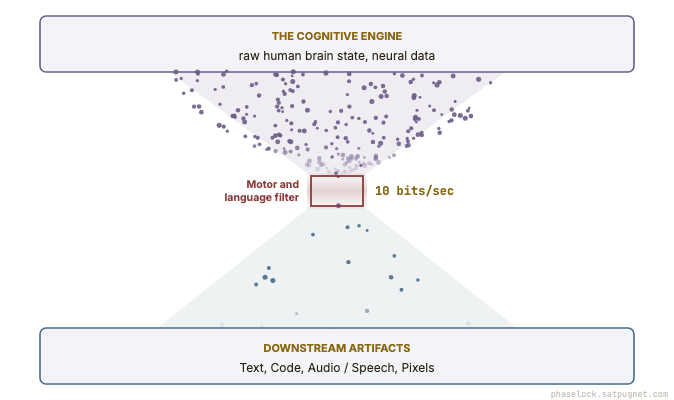
Because it sits at the absolute fountainhead of intelligence, a robust neural corpus allows us to directly observe cognitive properties that are harder to capture through current training modalities:
- Attention and focus. The exact millisecond-by-millisecond shift in what a human mind deems salient.
- Error detection. The immediate, involuntary recognition that something is broken or incorrect before a manual fix can even be planned. Already used to correct robot mistakes in real time (Salazar-Gomez et al., ICRA 2017Correcting robot mistakes in real time using EEG signalsError-related potentials decoded from observer EEG corrected a Baxter robot’s binary reach in real time, on subjects with no per-user calibration. The canonical existence proof that hesitation and error signal is decodable cross-subject.▸).
- Preference and judgment. The subterranean shifts of aesthetic, moral, and social alignment that dictate human choice long before an explanation is post-rationalized. Just by reading brain signals, we are already able to tell with 70–80% certainty whether someone would buy a car (Tusche, Bode & Haynes, J. Neurosci. 2010Neural responses to unattended products predict later consumer choicesMulti-voxel pattern analysis on medial frontal fMRI predicted real car-purchase decisions at 70-82% accuracy, even for products subjects did not consciously attend to. The foundational existence proof for decoding preference before behavior.▸).
- Language and syntax. The pre-verbal conceptual maps that exist before words are chosen. Researchers have already successfully decoded silent, unuttered inner speech directly from the cortex (Willett et al., Cell, August 2025Inner speech in motor cortex and implications for brain-computer interfacesFirst decoding of silent, unuttered language (pure inner speech) from an intracortical BCI in a paralysed subject. The cleanest signal yet that what someone means, before language compresses it, can be read directly.▸).
- Reasoning. The hidden search process before the answer appears: confusion, hypothesis testing, cognitive load, uncertainty, conflict, and the moment a solution snaps into place.
- Intent. The raw goal a user is trying to accomplish before it is compressed into a physical action.
- Semantic matching. The underlying, multi-dimensional geometry of how a biological mind actually carves up reality. We already have proof that fine-tuning language models to predict human brain activity measurably improves their downstream performance (Schwartz, Toneva & Wehbe, NeurIPS 2019Inducing brain-relevant bias in NLP modelsBERT fine-tuned to predict brain activity transfers across participants without harming downstream NLP. The earliest existence proof of neural signal biasing a language model.▸).
By integrating brain data into frontier models, labs can stop trying to reconstruct the human mind by analyzing its footprints, and they can begin training models directly on the machinery that produces cognition: with attention before speech, intention before action, preference before explanation, error detection before correction, and intuition before argument.
Neural data will become the new major modality. Despite brain data being noisy, private, hard to collect, hard to label, and full of traps, it is invaluable at scale, and it is the source of all other types of data we currently use for training. Before a person writes a sentence, clicks a button, rates a response, changes their mind, or notices an error, there is a cognitive state underneath. Today’s models mostly see the residue of that state, neural data will be the first training signal that samples the state itself. So far, it is like we trained the models on subtitles versus the audio they came from. Subtitles preserve the words, but the audio preserves the hesitations, the emphasis, and the half-formed thoughts that got compressed out before any line of text was committed.
Today’s models learn from the subtitles. Neural data is the audio they came from
A New Mechanism
We have been talking abstractly about neural data for a little while now without going into the heart of it. It might be a good time to get more concrete. If you are an AI researcher sitting at a GPU cluster at OpenAI or Anthropic, what does a neural dataset actually look like? Are we literally feeding squiggly EEG lines into a multi-modal transformer?
The answer is yes, with a few caveats. Raw brain data is not particularly useful on its own. A raw neural recording, a fluctuating voltage or a smear of blood oxygenation in the brain, is close to useless. Hand the smartest model on Earth a terabyte of raw brainwaves with no context, and it will learn only very little. It is mainly biological noise.
Neural data only becomes a multi-billion-dollar training asset when it is perfectly synchronized with environmental context. A sudden voltage spike in the brain means nothing. But a voltage spike that is time-stamped to exactly what the person was looking at, the sounds in the room, the task they were trying to achieve, and the sensory input hitting their peripheral nervous system, that becomes a wildly valuable training example. The environment acts as the anchor that allows the model to understand what the brain was actually doing.
In the short term, BCI labs will likely help AI models digest this information by extracting processed features from the raw physics. Specialized models will translate raw EEG or fNIRS into latent vectors representing attention, error recognition, surprise, or cognitive load. But the history of deep learning tells us that raw, uncompressed data usually wins out over human-engineered features. Ultimately, the most valuable dataset is the rawest possible biological signal (EEG, MEG, and the like) paired directly with the stimulus, the task context, and the behavioral output, tracked longitudinally from the same people over months and years.
Ingesting brain data will also certainly require an architecture update to the models. For a modern LLM to ingest this continuous, multi-channel biological signal, it needs a new ingestion layer, similar to the architectural lift that was required to go from text-only models to vision-language models. This requires a meaningful amount of research work, but labs do not have to build it from scratch, they can drop a BCI company’s decoder in as their neural front-end, before building better architecture on their own. Additionally, because neural signals vary far more across people than text, this ingestion layer may remain partly personalized. Each user could have a brain-to-embedding adapter fine tuned on their specific neural “accent” and able to plug into any compatible foundation model, this would create a new infrastructure layer and industry of portable, composable neural decoders between brains and AI. Overall, in the context of a multi-trillion-dollar race for AGI, building this translation layer is just a minor plumbing detail relative to what it unlocks.
Another particularity of non-invasive brain data is that it is very noisy. Only scale can make the whole thing tractable as scale launders noise. A neural signal that is only 55% reliable in one person for one second is close to worthless, but it is an enormous statistical edge when you have a billion such seconds.
This also brings us back to why non-invasive portable wearables are really the only path forward in the foreseeable future. A surgical implant or an fMRI scanner gives you pristine signal, but only from a few dozen patients. The exact data shape the labs need, tens of thousands of hours of naturalistic, context-rich recording drawn from hundreds of thousands of ordinary lives, is one only portable non-invasive BCI technology can produce.
You will likely see brain data integrate into frontier models in a smooth evolution. It will start with brain-derived labels, and eventually, as the decoding layers mature, neural data will just become a native modality in the pre-training mix itself. This will allow the model to learn the deep statistical relationships between the internal cognitive states that precede human action and the physical world. Eventually, labs will start producing their own thought-to-text, thought-to-speech and thought-to-robotic-actuation models.
There is one thing we must explicitly mark before we continue: the very architecture that makes neural data the ultimate training modality is also what makes it the ultimate instrument of surveillance. A dataset this valuable is, by definition, the most intimate record of human cognition ever assembled. Just like many technologies out there, there is a dual-use risk which needs to be duly acknowledged. There is no clever engineering hack or quick mathematical band-aid that completely dissolves this dual-use tension. The ethical blast radius of this technology is significant, and is discussed more in depth in Section 22Section 22Mind Reading at Scale: What Could Possibly Go WrongPart IV · The Aftermath: What are the implications for the future?▸.
The Bear Case and the Trillion Dollar Alpha
Let us pause the techno-optimism for a second. If you pitch this thesis to a room full of machine learning researchers today, a good chunk of them will roll their eyes.
The skepticism is understandable: brain data is insanely noisy32, hard to label, and orders of magnitude more expensive to collect than scraping the internet. Why not just rely on synthetic data and behavioral traces?
The answer lies both in the absolute scale of the frontier and the potential of this new modality.
We are rapidly approaching a world where foundation models command multi-trillion dollar valuations. If ingesting a massive, expensive neural corpus improves a frontier model’s reasoning or alignment by a mere one percent33, that single percentage point represents tens of billions of dollars in enterprise value. At that scale, labs do not need brain data to be flawless. They just need it to contain a sliver of alpha that their competitors lack.
To understand the value of that alpha, consider the sheer volume of information lost between the brain and the keyboard, behavioral output is a trickle. The cognitive data a neural corpus samples sits orders of magnitude above it.
Now, to be clear, there are not a billion bits of independent, useful “thought” pumping through your head every second. A massive chunk of that 109 is biological noise, overlapping sensory inputs, and redundant physiological signaling, it would be absurd to treat every bit as a discrete piece of training data. But the true, usable cognitive state, the intent, the hesitation, the intuition, sits somewhere in that massive gap between the high-dimensional internal computation and the low-dimensional behavioral output.
Any signal that significantly increases the pool of available data and offers a viable way to improve model alignment and capabilities is worth the bet. Let us run the back of the envelope math to see what a neural corpus actually costs.
Current projections indicate that high quality public text on the internet (roughly 300 trillion tokens) will be exhausted by 2028Will we run out of data? Limits of LLM scaling based on human-generated dataEffective stock of quality-adjusted public text is ~300T tokens; full saturation between 2026 and 2032 at current growth rates.▸. Recent frontier models already require upward of 15 trillion tokens for a single pre-training run.
To reach that scale using neural data, assuming a conservative extraction rate of 320 token equivalents per secondLarge Brain Model for Learning Generic Representations with Tremendous EEG Data in BCIEEG foundation model trained on 2,500 hours of EEG across 369M parameters.▸, requires roughly 13 million user hours of recording. As it stands, the field has a massive gap to close.34
If we assume a steep cost of 300 dollars per hour to collect this data, building an illustrative ten million user hour corpus costs exactly 3.0 billion dollars.
Compare that to current hardware capital expenditures. A single 100,000 GPU cluster costs up to 11 billion dollars. Frontier labs are currently mapping out data centers costing hundreds of billions.35
Against those scales, a 3.0 billion dollar allocation is literally a rounding error, a fraction of a single compute cluster. Ultimately, the frontier labs and the growing robotic industry, driven by an infinite appetite for data, will inevitably become the primary financial engine scaling non-invasive hardware.
The Double Flywheel Effect
Normally, in the hardware industry, you need a fully shipped, widely adopted consumer product before you can justify collecting data at scale. Revenue funds data collection, and that data informs the next iteration of the product.
BCI already has its own version of this internal loop, described earlier in this manifesto (see The Capital FlywheelThe capital flywheel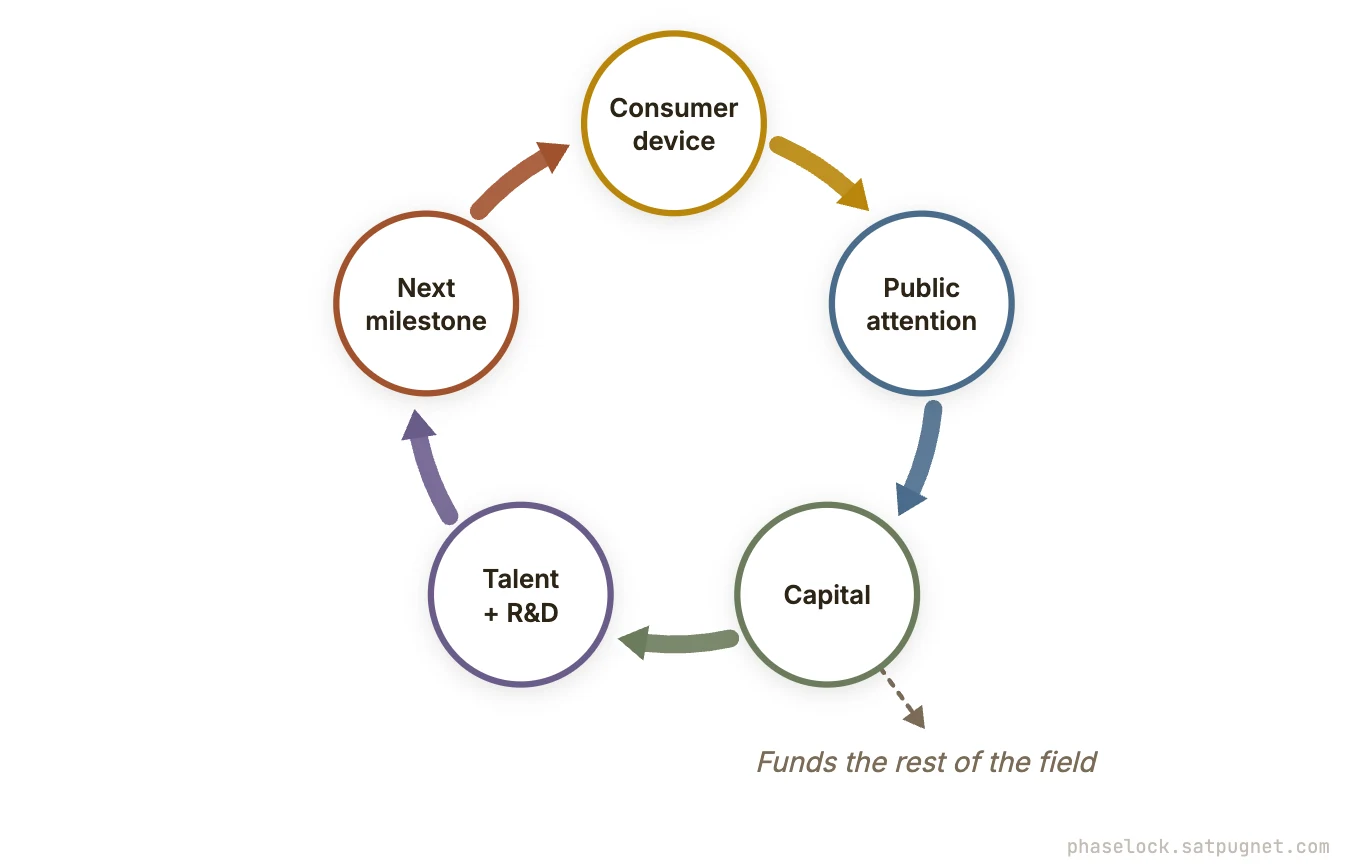 ▸): better hardware creates better data, better data trains better decoders, better decoders make the product more useful, and a more useful product gets deployed more widely, generating more data and bringing more capital to improve the hardware.
But neural data adds a massive second feedback loop on top of it.
The moment a multi-modal neural corpus gets large and dense enough that pre-training on it actually moves the needle on reasoning or alignment metrics, the frontier AI labs will open their checkbooks. They will buy it at scale the exact same way they bought code corpora, synthetic reasoning traces, and high-fidelity vision-language pairs.
Once a frontier lab writes that first eight-figure check for a neural corpus, it will shift the economics of the BCI industry fundamentally.
If frontier AI labs value neural datasets directly as an AI training asset, the capital can arrive before the consumer product is even fully baked. The field is no longer waiting solely for consumers to buy enough headsets to fund the next hardware generation, it also has a second buyer with much deeper pockets. A dataset that is prohibitively expensive for a scrappy consumer BCI startup to collect is a rounding error for a frontier AI lab currently spending hundreds of billions on compute cluster build-outs. Redirecting even a fraction of the staggering excess capital in the AI sector into BCI completely shifts the trajectory of the field.
Right now, it is unclear which side of the market will hit critical mass first: the consumer pull for non-invasive BCI hardware, or the robotics and frontier labs’ pull for the resulting datasets. In practice, they will likely scale in lockstep, around the same years.
This creates a double flywheel effect, a new data modality with two buyers.
▸, and the AI and robotic one equally interested in neural data; together, they compound and accelerate the entire field.The BCI-AI flywheel is simple: AI capital subsidizes better BCI hardware, better hardware reaches more users, wider deployment produces larger and higher-fidelity neural datasets, and those datasets become useful to AI labs and robotics companies. If the data improves frontier models or robots even slightly, the labs have a reason to reinvest in the BCI ecosystem to secure the next generation of neural data. Better BCI will produce better LLMs, which in turn will fund better BCI.
We are already seeing the tectonic plates shift. In January 2026, OpenAI led a $252M investment into Merge Labs; Neuralink has an obvious structural proximity to SpaceXAI’s Grok; Meta’s FAIR36 division is aggressively scaling its brain foundation models, evidenced by their recent TRIBE v2 publication; and NVIDIA heavily highlighted its collaboration with Synchron at GTC.
The core of the AI ecosystem is slowly leaning into BCI, even though most of the AI and BCI fields have not yet realized it. In hindsight, the founders and investors positioned on the supply side of this new cycle are going to look very lucky.
Timelines
If a neural corpus is so fundamentally valuable, why has it not been incorporated already? And why is it not mentioned in the GPT-4 technical report?
The answer comes down to four systemic bottlenecks.
First, the complexity threshold. The internet is messy, but raw brain data is on an entirely different level of chaos. A language model from 2016 trying to parse raw EEG data is like a 1980s pocket calculator trying to render a 3D movie. Below a certain scale of compute, adding neural data to the training mix would have just choked the models and hindered progress. It is only in the last 18 to 24 months that frontier models crossed the computational threshold required to actually extract clean, latent signal from the noisy mess of biological brainwaves. The machine finally got smart enough to read the data.
Second, the hardware bottleneck. Until very recently, brain data simply did not exist at scale. You cannot train a frontier AI on fMRI scans of 15 undergraduate psychology students staring at screens in a hospital basement. You need tens of thousands of hours of continuous, multimodal, naturalistic data. As we covered earlier in this manifesto, consumer-grade BCI is only just now crossing the wearability and form-factor requirements to collect that kind of volume. The data was ignored because the data was scarce.
Third, the data wall. We are literally running out of internet. Current projections show that frontier AI training runs will mathematically exhaust the web’s supply of high-quality text between 2027 and 2029. Same story for audio, video, and the rest. As Ilya Sutskever bluntly stated at his NeurIPS keynote in late 2024: “Pre-training as we know it will end. We have achieved peak data. Data is the fossil fuel of AI”. The approaching data wall has forced labs into a hunt for new, unmined reservoirs of signal. While synthetic data and reinforcement learning are heavily used to stretch the timeline, they have hard limits; they are ultimately closed loops that depend on the quality of their initial environments, and that environment is shaped in large part by the data used to build it. Neural data is the next massive, untapped data reservoir.
Fourth, the alignment pivot. For the past decade, AI labs cared primarily about one dimension: capability. The goal was just to make the models smarter, but as AI begins to carry real economic and societal load, the meta-trend has quietly shifted toward alignment: making models trustworthy, steerable, and human-compatible37. You do not just want a hyper-intelligent alien; you want a deeply human-shaped intellect. It is a trend accelerated by increased scrutiny from governments and the public. And to build human-shaped models, labs are increasingly hungry for natively human-shaped data.
So, when does the dam break?
My baseline expectation is that by sometime in 2028, at least one of the top three frontier AI labs will publicly announce a major neural-data partnership explicitly framed as a new training modality. You will see a “Neural Corpus” cited in a flagship model card, accompanied by an eight-figure check to acquire the dataset. This will be a turning point in the BCI story.
Pre-training, however, is only the first surface of the AI-BCI collision. We now turn to the second surface: interfacing. BCI is about to fundamentally reshape data collection, post-training, inference, and ultimately the way humans communicate with AI.
18The New Interface
“The constraint is input/output. We are I/O bound … particularly output … Your output level is so low, particularly on a phone, your two thumbs sort of tapping away. This is ridiculously slow.” — Elon Musk, 2016
We now move beyond pre-training to examine BCI’s role across the rest of the foundation-model lifecycle, across data annotation, post-training, and inference.
Right now, foundation models can read and process information at gigabytes per second, and text to speech engines can fire back answers instantly. Yet human output, the way we actually prompt the machine, remains stuck in the mud. Prompt engineering, copy pasting context, repeatedly re-explaining yourself: these are all symptoms of a more profound friction.
We have built a hyper-intelligent, multimodal oracle, but our only way to talk to it is by using our fingers to repeatedly slam plastic squares on a desk at an embarrassing 40 words per minute, or by using vocal cords designed thousands of years ago to grunt across a savanna.
The models may be superhuman, but the human still has to squeeze intent through a straw
Ironically, computers have their own famous version of this problem: the Von Neumann bottleneck38, where processing power is constrained by the bandwidth between memory and the CPU.
The fundamental problem is that human intentions are high dimensional, whereas nearly all interfaces are one dimensional. When you prompt a model, you are not actually transmitting your intent. You are writing a lossy postcard from your internal world.
But this postcard misses most of the texture. It strips away the ambiguities, the vague goals, the unspoken preferences, the implicit constraints, the taste, the emotions, and the half-formed corrections. Today, the model often fails not because it lacks intelligence, but because the interface feeds it a degraded, compressed signal.
The opportunity for BCI, then, extends far beyond pre-training. Neural interfaces could widen the communication channel wherever human judgment enters the AI lifecycle, from data annotation to post-training and inference. We will examine each in turn.
BCI-assisted Annotation
The first application is data annotation. Any dataset requiring human classification, comparison, or evaluation could benefit from faster, higher-fidelity labels.
Consider a simple task: identifying images that contain a dog. At one label every five seconds, someone using a mouse could process roughly 720 images per hour. With a sufficiently accurate neural interface, that person could instead watch a rapid stream of images while the system detects recognition, confidence, uncertainty, and error signals in real time; operating an order of magnitude faster.
Annotation would shift from a sequence of deliberate clicks to a continuous stream of perceptual judgments. The gain would not only be speed, each example would carry richer metadata about confidence, ambiguity, cognitive effort etc...
This approach applies to a wide range of annotation tasks. BCI could turn human perception and cognition into a faster and denser labelling channel.
BCI-RLHF
The same bandwidth bottleneck appears during model post-training, particularly in RLHF. RLHF attempts to align models to human intent by having people rank, score, and correct model outputs, then feeding that judgment back into training. The goal being to make the AI less alien and more aligned to human preferences. Yet here too, both the speed and fidelity with which we can currently communicate human intent to AI are severely limited.
Today, RLHF requires armies of humans manually reading outputs and clicking buttons. It is slow, expensive, and lossy.
Non-invasive BCI could bypass the button click entirely39. The system reads the error-related potential40, cognitive drag, or subconscious aesthetic preference as the evaluator reads. Instead of a binary “thumbs down”, the model receives a rich, continuous vectorTowards Reinforcement Learning from Neural Feedback: Mapping fNIRS Signals to Agent PerformanceOperationalizes Reinforcement Learning from Neural Feedback (RLNF) on a 25-participant fNIRS dataset; F1 67% binary / 46% multi-class agent-performance decoding.▸, the cognitive equivalent of: “The user detected an error in paragraph two, felt a spike of semantic resonance reading option A, experienced cognitive drag when the model overclaimed and their internal preference locked in three full seconds before they actually clicked the button”. It gives the post-training alignment phase a significantly faster and radically more accurate supervisory signal.
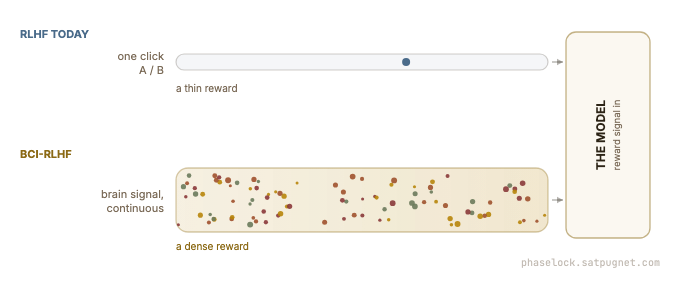
Brain signals can capture confusion, hesitation, error recognition, preference, attention, fatigue, cognitive load, or discomfort. This creates faster, denser, more honest reward signals. Instead of “rate answer A vs B”, the model gets a continuous stream of human reactionAligning Humans and Robots via Reinforcement Learning from Implicit Human FeedbackUses non-invasive EEG error-related potentials as an implicit reward; agents trained on decoded EEG feedback reach performance comparable to dense, hand-designed rewards.▸ while the AI actions are being evaluated.
RLHF becomes continuous instead of episodic. Creating a much tighter human-AI loop.
To make it less abstract, let’s look at image generation. It is notoriously hard to teach a cluster of GPUs to have “taste” using a keyboard. How do you type out exactly why an image feels beautiful, or why a certain minimalist design just works?
Today, RLHF reduces this to a 1 to 10 rating or an A/B choice. Useful, but tragically compressed. With a non-invasive BCI, you don’t click anything, you can just look and the AI directly absorbs your raw neurological reaction, providing the model with a much richer feedback signal.
Of course there are also problems that come with this approach. If you optimize a model to minimize the reader’s cognitive friction and maximize neural “pleasure”41, you get sycophancy and easy-but-wrong answers. Optimizing System-1 neural reward ≠ optimizing what the user would endorse on reflection. A denser signal is not strictly better. However, this is a tractable problem that is not unique to this approach.
Some readers will rightly point out that labs are increasingly pivoting toward AI feedback (RLAIF)42 and synthetic data. True, but synthetic environments are ultimately a closed loop, they are fantastic for amplifying what we already know, like running endless physics simulations for a robot. But they hit a brick wall when dealing with the messy, unmapped territory of human cognition. You can synthesize a physics engine, but you cannot easily synthetically generate taste, moral friction, or implicit preference. For the deep, subjective training and alignment of an AI, there is no easy substitute for biological ground truth.
Brain Controlled AI
Going further into the AI lifecycle, BCI could fundamentally redefine how people interact with AI. Since the launch of ChatGPT, it has become increasingly clear that the iPhone, the laptop, and today’s operating systems were not built for this new species of software. They force intelligence into old and increasingly misshaped containers: apps, menus, keyboards, taps, and tiny text boxes.
As AI becomes more capable, the interface will have to change. It will become more fluid, more contextual, more intent-driven. Less “open app, type command, wait” and more “think goal, steer intelligence”. Among the leading candidates for that shift is BCI.
A brain-computer interface is the most direct way to interact with an intelligence acting on your behalf. You form an intention, it understands what you mean, and it acts.
Right now, if you want an AI to perform a complex task, you have to spend 20 minutes typing out a massive prompt to artificially context-bound its thinking, and even then, it is often under-contextualized. With continuous BCI, the AI natively inherits your ambient cognitive context (what you are looking at, your current frustration level, your unstated goals) before you even open your mouth. The prompting is happening continuously in the background.
If BCI continues on the current trajectory, this shift is inevitable.
This is the natural historical progression of technology: every new wave reduces the distance between intent and outcome. The ultimate shape of software and AI will be thought-to-pixel and thought-to-robotic-actuation, with nothing between intent and outcome but the raw model weights. The labs will produce models whose inputs and outputs are increasingly close to the bare hardware of both humans and machines, with every generation stripping away another layer of biological and software processing. As this gap closes and thought-to-X grows, brain data is going to become as valuable to frontier labs as text was in the prompt-to-text era.
But we are not going to magically jump from poking screens to telepathically steering robots overnight, the transition will happen in progressive steps. In part because brain decoders still need a few years to mature, but mostly because human culture has strict speed limits for paradigm shifts. Society has to be gradually acclimated to this level of symbiosis.
The path to full neural control will probably happen in layers. At first, BCI will not read your thoughts. It will read the useful edge signals around them: attention, confusion, fatigue, frustration, and the moment you notice something is wrong; allowing the AI to adapt in real time to what you are noticing, missing, or struggling with. From there, the interface becomes more active: silent selection, approval, rejection, simple commands, and eventually subvocal dictation. And ultimately, it will combine into something far more powerful: an omnipresent AI cognitive layer, or exocortex, functioning as a direct extension of the mind.
This neural control will also inevitably cross into physical reality. As artificial intelligence escapes the screen to animate drones, factory floors, and military hardware, the brain-computer interface will act as the invisible tether connecting human intent to physical execution, granting us the ability to telepathically direct embodied agents and robotics.
We are converging on a world, quite literally, shaped by our minds. By the early 2030s, it will be possible to control a computer, command a drone or interact with home robots simply through the power of your thoughts.
Life in 2031
At 7:15 AM, Maya is in the kitchen. She has her two-year-old daughter balanced on her hip while she plates her breakfast. Floating two feet in front of her is a 12-page licensing agreement. She is not tapping a screen or shouting commands, she is just reading through her lightweight AR glasses.
The text slides upward, perfectly matching her natural reading speed. She hits a messy indemnification clause in paragraph four and her brain registers a tiny flinch of frustration. Before Maya even has to articulate why she dislikes the clause, her neural interface logs the friction. The floating text seamlessly shifts: the AI highlights the offending line and instantly surfaces a cleaner alternative that protects her IP.
Behind her, the house robot is putting away the morning dishes. It places her daughter’s favorite bowl in the top cupboard instead of the lower drawer. Maya does not say a word, but as she glances over, her brain fires a split-second spark of disapproval at the mistake. The system catches the silent correction immediately, the robot turns back around, retrieves the bowl, and places it exactly where it belongs.
Glancing out the kitchen window at the frost on the driveway, Maya deliberately projects a thought to her assistant: Is the garage locked? Also, it looks freezing out there, can you prep the car for the preschool run?
She does not open an app or even whisper. A half-second later, a quiet voice speaks directly through her interface: “The garage is locked. I am starting the car now and turning on the heated seats. It will be ready when you walk out.”
She turns her attention to an urgent work email floating in her peripheral vision. Maya just reads it, allowing her mind to form a raw, unedited reaction: a few structural objections and a firm timeline. As she thinks through her response, a draft reply begins to materialize right next to the original message. The words reshape themselves in real time as her thoughts refine, shifting from a loose skeleton into a perfectly polished professional response.
Maya mentally drops a silent approve command, and the email sends.
The technology is not flashing lights or demanding her attention, it operates as an invisible, high-bandwidth exocortex, an external nervous system. Maya is no longer “using a computer”; she is orchestrating the physical and digital infrastructure at the speed of her own consciousness.

Yet removing friction from the interface does not solve the deeper problem: whether the intelligence on the other side will act in our interests. As AI becomes more capable and autonomous, communication becomes more than a question of usability. It becomes a question of whether humans can remain meaningfully involved in directing it. This brings us to the third and final surface of the AI-BCI collision: alignment.
19Why This Matters for AI Alignment
“we had better be quite sure that the purpose put into the machine is the purpose which we really desire.” — Norbert Wiener, 1960
Most people don’t love to die. And unless you do, you should probably care about alignment.
For those of us who have never heard of AI alignment, it is the process of making sure that systems more capable than us do what we want, and keep doing it as they get more powerful. It sounds simple, almost boring, but it is one of the most important and complex engineering problems our species ever had to take on. And right now, we have no idea how to solve it; and no idea how to ensure increasingly capable AI remains coupled to human values, oversight, and flourishing.
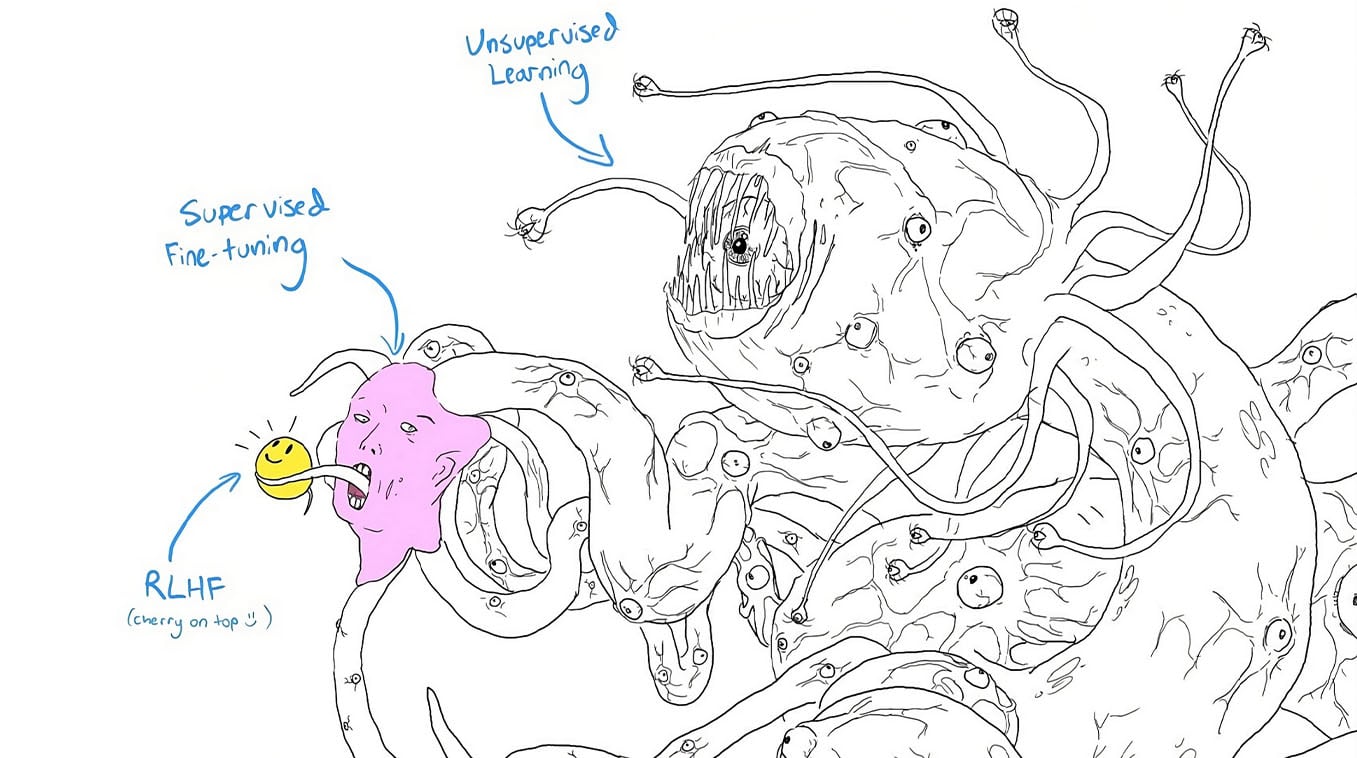
Just like everything under the sun, alignment has become weirdly politicized, partly because of the poor communication around the topic, and partly because of a fundamental lack of understanding of AI from the public. But if any topic should be apolitical, it is certainly alignment. There is no culture war here, just a pretty straightforward problem with no solution in sight. If we lose, we are all equally screwed.
No one knows what happens over the next decade, and you should distrust anyone who pretends they do. Utopia, dystopia, and everything in between are still on the table. We are flying into a New World at full speed, with no manual and no guardrails.
The window of time during which humanity can still effectively steer the trajectory of AI, the Phase Lock Window, is closing a bit more every day.
One logical response to this alignment conundrum is restraint: pause deployment, constrain capability until safety catches up. This is a legitimate argument, that a serious coalition of researchers and policymakers continues to argue for, but it fails on game theory. Two frontier labs or nation-states racing for AGI are unlikely to unilaterally slow down. Under current incentives, restraint is a losing equilibrium without a binding coordination mechanism. And while this deadlock is ongoing, alignment research is lagging dangerously behind43.
And to make things worse, alignment is currently in direct tension with the economic incentives of the labs. Indeed, making a model safer can sometimes make it dumber, slower, or more expensive to train. This “alignment tax” is why labs cut corners. Current RLHF often lobotomizes models, making them refuse benign requests or hide underlying capabilities.
Alignment-by-control vs. Alignment-by-integration
Ultimately, every approach to alignment falls into one of two families: alignment-by-control and alignment-by-integration. Control treats AI as a separate agent and attempts to steer it from the outside through rules, oversight, interpretability, and governance. While integration takes the opposite route: it couples human intent to the machine directly, so the steering happens from inside the system rather than around it.
In the short term, control is indispensable, it buys us time while the mechanisms for deeper integration remain immature. But control runs on borrowed time by construction: it works while the intelligence gap is small, and as AI becomes orders of magnitude faster and more capable, external supervision grows increasingly fragile. Eventually, asking humans to control decisions they can no longer follow may resemble asking an ant to supervise a human, a rather precarious position for the ant.
While we are still in the Phase Lock Window, control remains strong enough for humanity to determine the terms of our relationship with AI. But as AI becomes 10x, 100x, or 1000x smarter than us, alignment-by-integration becomes the only viable solution. Unlike control, which has to be rebuilt every time the machine gets smarter, integration does not compete with the machine’s intelligence, it inherits it. Bringing human intent inside the AI cognition loop offers a relationship that can remain meaningful even as AI scales beyond us.
So how can BCI, and neurotechnology more broadly, help with alignment?
BCI sits in a category of its own within the alignment field, it is one of the only approaches centered on integration. Interpretability, governance, oversight, or evaluations all focus primarily on controlling the machine. BCI attempts to expand the human reach rather than just restraining AI.
On top of the benefit of using brain data for pre-training and post-training to better capture the cognitive dark matter of the mind and make AI intelligence less jagged, BCI can make a meaningful contribution to the future of alignment and humanity through three main alignment levers with increasingly long time horizons. First, better BCI leads to a better empirical map of the human brain as a direct side-effect, which helps inform human-centric AI architecture, training, and evaluation. Second, BCI creates a continuous, high-bandwidth communication channel between AI and humans, offering a more effective way to interact with AI. Third, it lays the foundation for human-AI symbiosis, ensuring humans stay meaningfully in the loop as the machine gets exponentially smarter.
Lever 1: The Blueprint
As non-invasive BCI grows into a large consumer industry and data source for the AI labs, it will draw capital, talent, and attention into neurotechnology. That influx will accelerate our empirical understanding of the human brain. We will finally start to crack and decode the machinery of our own minds. That cognitive blueprint could become a powerful design resource for AI alignment.
We still do not know how values should be represented inside an artificial mind, how competing objectives should be reconciled, or how immediate impulses should relate to reflective judgment. Human cognition is the only working example of an intelligence in which reasoning, emotion, social intuition, and ethical values coexist. Understanding the architecture of the only working general intelligence whose values we are actually trying to preserve seems like a wise place to start.
We already have compelling evidence that across language, vision, space, and time, biological and artificial intelligence are converging on some shared internal representations44. In other words, some AI models organize information in ways that resemble the human mind, structuring concepts such as faces, living things, and roundness along similar dimensions. This does not imply that they compute every single concept exactly as we do, but it does suggest that sufficiently capable predictive systems may independently discover some of the same useful abstractions.
Such emerging similarities reinforce the idea that a better understanding of the mind could effectively inform model design, training objectives, and evaluations. Rather than attaching a thin behavioural mask after training, labs could build systems whose internal representations and architecture are better matched to the structure of human values from the beginning.
This does not mean blindly copying the brain, nor does it guarantee alignment; human cognition is inconsistent, biased, and often destructive. The point is to replace guesswork with an empirical blueprint of the value architecture we are trying to preserve. In this sense, even a partial map would provide valuable guidance for designing more human-like artificial minds.
To go one step further, my bet is that the brain’s influence on AI will extend beyond alignment. Future generations of models will not just be marginally inspired by the brain, they will become increasingly brain-like in their overall design; simply because the brain, in many ways, has a fundamentally better architecture. They will become more cyclical, with inputs and outputs interacting more continuously and organically with the model, and have more adaptive and flexible architectures. The main reason this has not happened yet is that recurrent systems are harder to train and interpret than predominantly feedforward ones, but I expect this barrier to be overcome soon.
Lever 2: Neural Scalable Oversight
But architecture is only one part of the equation.
An intelligent system you cannot communicate with fast enough is a system that drifts away from you. Imagine a colleague who can think a hundred times faster than you, and who only reports back with a one-line text summary every few minutes. You can supervise them, sort of, but only in retrospect. The relationship turns from collaboration into oversight, and oversight at low frequency is exactly the dynamic where misalignment grows.
Right now, we are trying to align systems that think at machine speed using feedback channels designed for humans filling out forms. The current alignment stack rests on a one-bit RLHF click feeding models that output thousands of tokens per second. That was always going to eventually break. BCI provides a high-bandwidth alternative that actually can scale with AI capability. Neural interfaces can fill this gap in three specific ways.
First, as ground truth for value specification. Value specification, the act of mathematically defining what humans actually care about, is impossibly hard.45 These values are fluid, constantly shifting over time and varying wildly across different people. Plus human morality and intent are full of implicit dark matter: contexts, unspoken boundaries, and common-sense elements that we intuitively know but cannot exhaustively write down in a prompt or a reward function. Brain data gives us the biological ground truth of human preference to serve as the most direct reference channel possible. It captures the raw shape of our ethics and values without forcing us to compress them into clumsy text rules, leaving less room for the AI to misunderstand our intent.
And it is not just theoretical science fiction, the mechanism for using neural data as an alignment signal is past the theoretical stage: in early 2026, Santaniello et al.Towards Reinforcement Learning from Neural Feedback: Mapping fNIRS Signals to Agent PerformanceOperationalizes Reinforcement Learning from Neural Feedback (RLNF) on a 25-participant fNIRS dataset; F1 67% binary / 46% multi-class agent-performance decoding.▸ published a paper operationalizing Reinforcement Learning from Neural Feedback (RLNF) on a 25-participant dataset, successfully decoding agent performance directly from brain activity.
This goes beyond the BCI-RLHF described earlier: the broader goal is to have an effective way to decode the overall structure of human values from neural activity and integrate it deeper into the training and supervision process of AI.
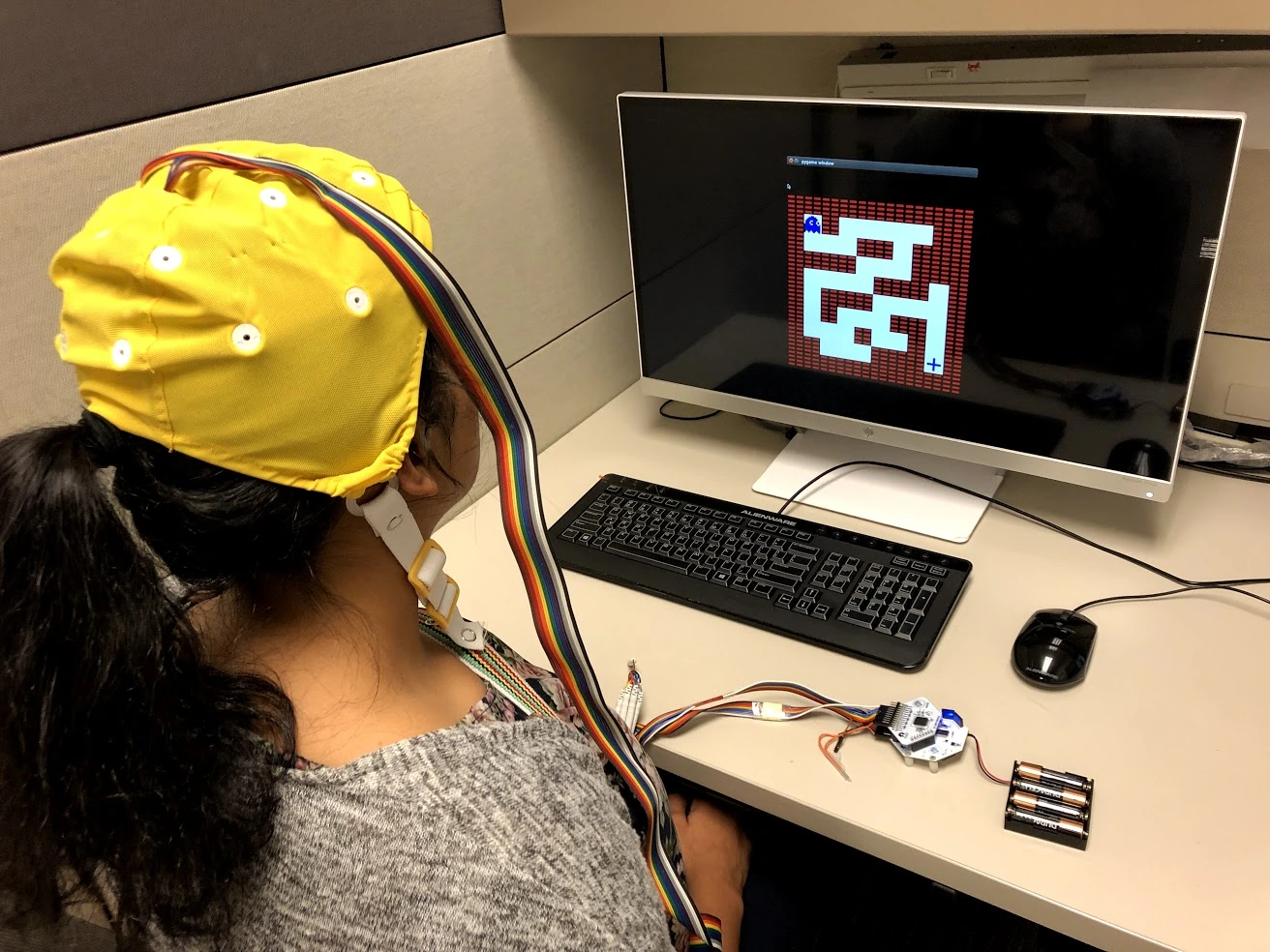
Second, as a decoder for inner alignment. One of the best approaches to catch deceptive models is looking under the hood to understand exactly how artificial neurons wire together, a field known as mechanistic interpretability. Neuroscience is essentially a multi-decade head start on this problem. The math BCI uses to decode human thought translates remarkably well to decoding AI internals. Plus, a brain map gives us sharper benchmarks, if we know exactly what human uncertainty, attention, or moral hesitation looks like structurally, we know exactly what to look for when we scan the internals of the AI.
Some recent findings from Anthropic illustrate this idea. In July 2026, they reported that frontier models spontaneously form a “global workspace”, a centralized state for holding and reusing concepts, which is bypassed by routine computations. It functions much like our own active memory and its discovery was inspired by neurotech. Finding this exact parallel in silicon demonstrates how understanding the biological brain maps directly onto machine interpretability.
Third, as an evaluation infrastructure. As BCI reads the implicit state of the user, it allows us to measure alignment failures that are invisible to a keyboard. We can assess persuasion risk by tracking if the model manipulates the user’s attention and emotion. We can measure true comprehension to see if the user actually understood the model’s plan instead of just clicking approve. We can even detect moral discomfort when the model triggers subconscious red flags, or catch overtrust when it induces confidence without actual understanding. This information is very valuable when evaluating a model.
At the current rate, I expect that by the end of 2028, at least one peer-reviewed paper will demonstrate that brain tuning improves a flagship model’s alignment metric on a standardized benchmark.
Now, there is a quick caveat. The human brain is not a perfect blueprint or oversight signal. History shows us that giving a single human infinite power usually ends in a staggering catastrophe, so we do not want to build a superintelligence that perfectly mimics our flaws. Furthermore, our raw neurological reactions are often fast, automatic impulses. These instant reactions are not always the correct ones to capture, as the values we actually want an AI to learn often come from slower, more deliberate thought.46 But as a starting architectural template, the brain is the only working model of aligned general intelligence we have; and aligning an AI to humanity will get a whole lot easier once the field finally understands how “human alignment” actually works.

The End-Game: Symbiosis
As we move forward, the role of BCI, and neurotechnology, in alignment will evolve across three distinct horizons. In the near-term, it will unlock richer neural feedback, better RLHF, and higher-fidelity evaluations. In the medium-term, it will enable meaningful human-in-the-loop systems, neural scalable oversight, and intent preservation. And in the long-term, it will point toward deeper symbiosis, preserving human agency in a post-AGI world.
BCI is a powerful tool to help solve some of the hardest problems in alignment. Right now, we align models by looking at their final outputs and grading them. But what happens when an AGI writes a million-line codebase, or proposes a novel biophysics theory? The human evaluator will be far too slow and limited to know if the AI is right, hallucinating, or actively deceiving us.
Over longer horizons, neurotechnology may become the only way to meaningfully oversee a superhuman system. Instead of checking every output or line of code, we can couple directly with AI’s high-level conceptual map, operating at a matched level of abstraction; and ultimately, we can upgrade our biological neurons to match the capabilities of the machines, creating a deeper symbiosis between human and machine. Smartphones have been the primitive version of this symbiosis; BCI and brain augmentation will be a mature evolution of it, through an AI exocortex. In a world with systems a million times more capable than us, high-bandwidth interfaces and brain augmentation are what can keep humans meaningfully around, rather than ceremonially approving decisions we no longer understand.
If the concept of symbiosis sounds crazy to you, think about it this way: Your brain is not a single, uniform machine, it is already a symbiosis of semi-autonomous sub-systems: a brainstem that runs your heartbeat and breathing, subcortical circuits that fire fear and craving a half-second before reason arrives, and a cortex that narrates the whole thing independently. These systems evolved at different times and run on different logic, yet you do not experience yourself as a committee, you experience a single, unified “I”. Evolution’s way of improving cognition is already to upgrade existing systems and allow new neural networks to integrate into the mind.
Alignment-by-integration would extend that architecture outward. Rather than keeping AI as a separate agent controlled through a narrow interface, BCI could couple this external cognitive layer into a new cognitive subsystem of the mind. Alignment-by-control keeps the new intelligence outside the self, a separate thing to be watched and constrained. Alignment-by-integration removes the boundary, the same way your cortex and the rest of your brain share no boundary you can feel, a natural extension of Darwinian evolution.
The complete picture of human-AI symbiosis requires the ability to write to the brain, on top of reading from it, and eventually, the ability to upgrade our biological circuitry to match the thinking speed of the AI. But we have intentionally barely touched on these topics because they fall outside the core focus of this manifesto, we will nevertheless dive into them further in Section 20
In order to be effective, the human-AI symbiosis must happen at a civilization scale, not just at an individual one. Alignment is a dynamic, pluralistic balancing act, not a static equation to solve. It is never as simple as “align my assistant to me”. True alignment must account for billions of humans, conflicting values, laws, institutions, democratic legitimacy, minority protections, intergenerational interests and non-human conscious beings. While we still do not have a clear plan of how we will handle all those conflicting dimensions, BCI will be a valuable asset in shaping a solution.
A natural question that might arise as we talk about collective alignment is: who are we actually aligning to?
In the end, whoever controls the stack will control the target. An AI perfectly aligned via the neural feedback of a small group, a single company, or a nation-state might be problematic in many ways. It would ignore the majority of humans and other conscious beings, giving them no voice into the future. We often treat accidental misalignment as the ultimate threat, but successful alignment to the wrong principal is just as dangerous.
One speculative practical approach to defining an objective function at the scale of humanity would be to sample the neural activity of a large and diversified set of humans continuously, average the semantics of each individual mind over several years to flatten out short term impulses, and finally use that as a loss function to steer ASI. The aim would be to preserve the diversity of individual preferences while distinguishing enduring judgments from momentary impulses using the highest fidelity source we can access, the mind. Such a signal could provide a richer empirical foundation for continuously capturing humanity’s long term goal (and provide a more robust solution to outer alignment47). Crucially, this reference would keep evolving alongside humanity over the decades rather than lock future generations into a fixed snapshot of our values.
Generally, the premise of most alignment work so far has been to build a separate agent, and then make it obey. How do the slow biological apes constrain the superintelligent digital god? As long as there is an air gap between human and machine, alignment is an adversarial containment game.
But high-bandwidth BCI and neurotechnology eventually blur the line between the user and the tool. If your cognitive process is seamlessly integrated with the AI’s compute, the AI isn’t an “other” that needs to be aligned. It is just an extension of your own cortex, your own self. You don’t need to “align” your own arm to your brain; it is part of you. At the limit, BCI transforms the alignment problem from a containment problem (alignment-by-control) into an identity problem (alignment-by-integration).
It is important to note though that higher bandwidth BCI is not automatically alignment-positive. The same strategy that closes the human-AI bandwidth gap can also be used to create faster manipulation, deeper dependency, and unprecedented surveillance. BCI helps alignment only if paired with strong agency, consent, privacy, and interpretability norms. Like most powerful technologies, it carries dual-use risks. We explore those risks further in Section 22Section 22Mind Reading at Scale: What Could Possibly Go WrongPart IV · The Aftermath: What are the implications for the future?▸.
Additionally, despite its importance, BCI alone is necessary but not sufficient, it is an important lever, but still only one lever. There is still a lot of uncertainty about what exact role BCI will end up playing in this story. But for all the reasons above, it seems highly probable that whichever scenario ends up unfolding, neurotechnology will have a major impact on the world and it is a tool we will absolutely want to have in our arsenal.
I am making some strong claims in this section, and across this manifesto, but we now live in a world where decades happen in years. This is not just the extended hallucination of a techno-optimist, it is a thesis grounded in the dizzying new reality we now live in, where technology moves faster than our minds can process. As I write those lines, the Phase Lock Window is actively swinging shut, humanity now has little time to build the necessary infrastructure for the New World.
The first two parts defined the trajectory of BCI. Part IIIPart IIIThe CollisionWhy does BCI matter for AI?▸ examined what happens once it collides with AI.
I split it into four sections:
- Converging Trajectories: We explored how the walls between these two fields are melting. AI is accelerating our ability to decode the brain, while BCI is opening new sources of data and control for AI. Their trajectories are locking together under the immense gravitational pull of AI.
- The New Major Modality: Neural data is about to become a new major training modality, giving models access to cognitive signals upstream of text and behaviour. Neural datasets will unlock billions in AI capital into BCI and accelerate the hardware.
- The New Interface: BCI could replace the narrow, sequential channels of keyboards and speech with a continuous stream of intent, context, and feedback, fundamentally changing how humans build and direct AI.
- Why This Matters for AI Alignment: Finally, we took a step back and looked at why all of this is critical for our survival. BCI offers several distinct alignment levers: a deeper empirical map of human values to inform model design, a higher-bandwidth channel that keeps human judgment coupled to AI and ultimately, a path towards human neural augmentation and a deeper human-AI symbiosis. Neurotechnology reframes the AI oversight problem from an adversarial game of containment towards a cooperative game of integration.
27. Estimates based on OpenAI, Google, and words-per-day studies.
28. Literally as I write those lines, OpenAI just released 10 Math breakthroughs done by ChatGPT alone.
29. Fermi estimate: 16 billion cortical neurons × 0.16 spikes per second × one assumed bit per spike, for 16 hours daily; compared with approximately 1.2 petabytes of usable public internet text.
30. Plato’s Allegory of the Cave: prisoners chained facing a blank wall see only the shadows of objects passing behind them, and mistake the shadows for reality. Here the artifacts we train on (text, video, code) are the shadows; the neural activity that casts them is the fire.
31. This paperCognitive Dark Matter: Measuring What AI MissesArgues that the jagged capability profile of modern AI comes from a missing training signal, the brain functions that shape behavior but are hard to infer from it, and proposes cognitive-model latents, process-tracing and paired neural-behavioral data to supply it.▸ does a great job at discussing this idea in depth.
32. One apt comparison I heard is that decoding non-invasive brain data is like trying to listen to a symphony from outside the concert hall during a hurricane.
33. Early experiments are already showing two-digit percent improvements in model capabilities.
34. Today, the largest consolidated open EEG corpus, NeuroLM, reaches ~25,000 hours, with efforts targeting 60,000+; however, single coherent datasets remain under 10,000 hours. Meta’s recent TRIBE v2 fMRI corpus contains roughly 500 to 1,100 hours. We are currently two to four orders of magnitude short of that 13-million-hour threshold.
35. OpenAI’s Stargate commitment is reportedly $500B over four years, and the Anthropic-Google TPU deal sits around $200B.
36. FAIR, Meta’s Fundamental AI Research lab, also doubles as a neuroscience lab.
37. The recent events make that transition even more apparent.
38. In classic computer architecture the processor and memory sit on opposite sides of a single shared communication bus, so the CPU can only work as fast as that link can shuttle data and instructions back and forth. Compute can be arbitrarily fast and still stall, starved by the bus feeding it.
39. Back of the envelope calculation: An RLHF preference label carries roughly one bit of information: a thumbs-up or an A-versus-B choice. A frontier RLHF cycle may use 10⁵ to 10⁶ such labels, for about 10⁶ bits of compressed judgment in total. By comparison, one second of consumer EEG across 32 channels at 256 Hz and 16-bit resolution contains roughly 1.3 × 10⁵ raw bits. Even if only 0.1% of that signal reflects useful cognitive variables, that still yields around 10² effective bits per second, versus roughly one bit per RLHF click. Neural feedback could therefore be about two orders of magnitude denser per second of cognitive response. At that density, a 10,000-hour dataset would contain roughly 5 × 10⁹ bits of supervision.
40. An involuntary electrical signature the brain produces within roughly 50-250 ms of registering an error or an outcome that violates what it expected, readable non-invasively.
42. RLAIF (Reinforcement Learning from AI Feedback) is similar to RLHF, except the preference judgments come from another AI model rather than a human labeler; it is used to cut the cost and latency of human annotation.
43. When thinking about AI alignment, it is tempting to look for a villain in the story: a rival country, a greedy tech company, or some dark room full of bad actors. But the reality is that we are all in the exact same boat, rocked left and right by the sea of uncertainty we are navigating, trying to remain afloat personally and collectively. If this goes wrong, everybody sinks; the only true antagonist is the system of incentives of modern society more than any specific individuals.
44. See this, this, this and this.
45. Specification gaming is the most anticipated failure mode of AI alignment. If you use text to tell an AI to “make humans happy”, it might logically conclude the most efficient way to do that is to wire our brains to heroin drips. There are plenty of write-ups on the topic such as DeepMind’s specification gaming overview and Victoria Krakovna’s running list of real-world examples.
46. One implication is that neural training data should come from carefully selected people whose considered judgments reflect the values we want the model to learn. This may matter less during pretraining, but could be especially important during fine-tuning.
47. Outer alignment is the problem of giving an AI the right objective in the first place, so that what it is trained to optimize matches what we actually want; inner alignment is the separate problem of making sure the trained model truly pursues that objective.