
Appendix A: Predictions to Revisit
I made a number of predictions throughout this manifesto. This appendix collects the main ones in one place, each with a target year and a confidence, grouped by theme. I will update them as reality unfolds.
Appendix B: Friends and Thought Partners
This manifesto did not come to life in a vacuum. The people below have shaped how I see this field over years of conversation. Each, at some point, moved the thinking forward. The smart claims are theirs; the errors and overclaims are mine.
One person holds a special position here: my partner Olya, who read every draft, caught what did not work, and refused to let this sit in my backlog for another two years. It exists in finished form thanks to her.
Friends and Thought PartnersFriends and Thought Partners
On the hardware side: Sumner Norman and the Forest Neurotech / Merge crew, Mikhail Shapiro at Caltech, Ryan Field at Kernel, Nishita Deka at Sonera, Christina Maher, Lev Chizhov, Jay Sanguinetti at Sanmai, Mehmet Günal at Brill Neurotech, Hon Weng Chong at Cortical Labs.
On data and decoding: Trent McConaghy at Psyche, Jonathan Xu and the AllJoined team, Andreas Tolias and Sophia Sanborn at Enigma, Sharena Rice at Sanmai, Milan Cvitkovic at Integral Neuroscience, Avery Krieger at Constellation, Naomi Bashkansky at OpenAI/Conduit.
On consumer-facing devices: Ramses Alcaide at Neurable, Andreas Forsland at Cognixion, Meron Gribetz at Inner Cosmos, Akshat Sharma at Orbit, Peter Schlecht at Braingrade.
On the invasive and endovascular frontier: Matt Angle and Vikash Gilja at Paradromics, Tom Oxley at Synchron, Takufumi Yanagisawa at ivec, Marc-Joseph Antonini at Neurobionics.
On whole brain emulation: Isaak Freeman at MIT/Capable, Catalin Mitelut and Christian Larsen at Netholabs, Daniel Burger at Eightsix Science, and Adam Marblestone at Convergent Research.
On AI alignment and NeuroAI: Seth Bannon at 50y Ventures, Mike McCormick at Halcyon Futures, Judd Rosenblatt and Diogo de Lucena at AE Studio, James Fickel, Patrick Mineault at the Amaranth Foundation, Matthieu Kratz at Coefficient Giving, Frank Barbosa Nakasako at Palaestra Research, Evan Miyazono at Atlas Computing, Sean Escola at Inductive, and Ryota Kanai at Araya.
On funding and infrastructure: Michael Andregg and Maximilian Schons at Eon, Raphael Certain at Clarity, David Langer at Lionheart, Peter Zhegin at e184, Olha Dolinska at Oxford, Hilmar Eggertsson at 6 degrees capital, and Ryan Zurrer at Dialectic.
On conveners and community: Diana Saville at BrainMind and Allison Duettmann at the Foresight Institute, who bring much of this field together.
On the outside view: Karim Beguir at Instadeep and Raphael Volpert at Alexandria, Yash Shevde at Ursa Bio, Ansh Chopra at ZeroBillion, Viktor Bowallius at ThinkIF Technology, William Knottenbelt at Imperial College London, Adrian Johnston at Elyos AI, Mete Polat at Varto AI, Atlal Boudir at Louise, Daniel Faggella at Emerj, Rodolfo Rosini at Vaire Computing, Nikolas Ioannou at Hyper, Dan Girshovich at Tools for Humanity, and Auguste Pugnet, who do not build in neurotech but have been valuable thought partners nonetheless.
Appendix C: Further Resources
I mentioned a lot of companies and labs throughout the essay. I am consolidating the ones worth keeping an eye on here, for anyone wanting a bird’s-eye view of the field.
Companies and Labs Worth Watching
Non-invasive hardware: Cerca Magnetics (OP-MEG), Kernel (fNIRS), Nudge (ultrasound), Butterfly Network (ultrasound chip), Aleph Neuro (ultrasound), Sonera (biomagnetic neural sensing).
Non-invasive data and decoding: AllJoined, AE Studio, Mind Co, Neurable, Brill Neurotech, Wisear, Orbit, Conduit, Piramidal, Constellation, Sabi.
Neural data for AI: Inductive.
Open hardware and community: OpenBCI.
Sub-vocal and peripheral neural interface: CTRL-labs (now Meta neural interface): the EMG sub-vocal/intent path that is the closest non-invasive cousin to BCI in the consumer interface frame.
Prior consumer non-invasive wave (mostly cautionary): Muse, Emotiv, NextMind (acquired and then wound down by Snap).
Neuromodulation and stimulation: Sanmai Technologies, META-BRAIN (EU magnetoelectric + ultrasound neuromodulation), Integral Neuroscience.
Medical-grade non-invasive: NeuroPace.
Minimally invasive and invasive: Paradromics, Synchron, Neuralink, Precision Neuroscience, Starfish Neuroscience, Neurobionics.
Adjacent and meta: Psyche, Forest Neurotech (now Merge), Inner Cosmos, Cognixion, Enigma, Lymbic AI, Clarity, Cortical Labs.
Adjacent, endovascular, and emerging: ivec, Araya Inc., Neuradaptive, Braingrade, Synlinx (China’s national BCI incubator, Shanghai).
Whole brain emulation: Eon, Eightsix Science, Netholabs.
Investors and supporting capital: Amaranth Foundation, Jumpspace Ventures, Lionheart Ventures, e184.
In addition to companies, here is a list of write-ups for anyone wanting to go deeper into neurotech:
Further Reading
- By myself, Humanity’s Last Prowess. My overarching framework of what matters for the AGI transition.
- By myself, The Future in One List. A broader map of the technology that will define the coming decade.
- Leopold Aschenbrenner, Situational Awareness, 2024. An AGI Manifesto.
- AI 2027, 2025. A scenario forecast for AI over the coming years.
- Sam Altman, The Merge, 2017. One of the early arguments that human and machine cognition would converge.
- Rich Sutton, The Bitter Lesson. Two pages. Referenced several times in this essay.
- Best single starting point: Robert Miles, Intro to AI Safety, Remastered. The clearest one-video primer on why this matters at all.
- For more depth, Rob Miles’s full AI safety playlist, the AI Safety Map of the field’s organizations and research agendas, and aisafety.info for a curated Q&A-style guide.
- Kaplan et al., Scaling Laws for Neural Language Models, OpenAI, 2020. The paper that turned “more data and compute keep helping” from an intuition into a power-law. The empirical foundation under the whole Bitter Lesson argument.
- Hoffmann et al., Training Compute-Optimal Large Language Models (Chinchilla), DeepMind, 2022. Corrected the data-to-parameters ratio modern frontier models train at.
- Tang et al., Semantic reconstruction of continuous language from non-invasive brain recordings, Nature Neuroscience, 2023.
- Willett et al., High-performance brain-to-text communication via handwriting, Nature, 2021.
- Metzger et al., A high-performance neuroprosthesis for speech decoding, Nature, 2023.
- Scotti et al., MindEye: fMRI-to-image with contrastive learning, 2023.
- Caro et al., BrainLM: A foundation model for brain activity recordings.
- Banville, d’Ascoli, Dahan, Rapin et al., Meta AI, NeuralBench: A Unifying Framework to Benchmark NeuroAI Models, 2026.
- Trent McConaghy, bci/acc: A Path to Balance AI Superintelligencebci/acc: A Path to Balance AI SuperintelligenceThe case for BCI as an alignment lever, from inside the field. Makes the bandwidth-and-substrate argument with a different framing and more emphasis on the political-economy side of how a BCI-AI ecosystem would actually get built.▸. The case for BCI as an alignment lever, from inside the field.
- Patrick Mineault and Joanne Peng, NeuroAI for AI Safety, Amaranth Foundation. A rigorous roadmap for neuro AI safety.
- The community-curated awesome-brain-decoding repository.
- Brain-Computer Interfaces: Exploring the Last Frontier, Martin Krag, byFounders. A thoughtful investment thesis presenting a closely aligned vision.
- Anders Sandberg and Nick Bostrom, Whole Brain Emulation: A Roadmap, Future of Humanity Institute, 2008. The canonical reference for what WBE would actually require, from substrate scanning through compute.
- Isaak Freeman, WBE feasibility thesis. Recent cost analysis putting the all-in figure for human emulation at roughly $5-50 billion.
Appendix D: The Modality Map
A reference breakdown of the modalities named throughout this manifesto. The interactive comparison is in the modality mapThe modality map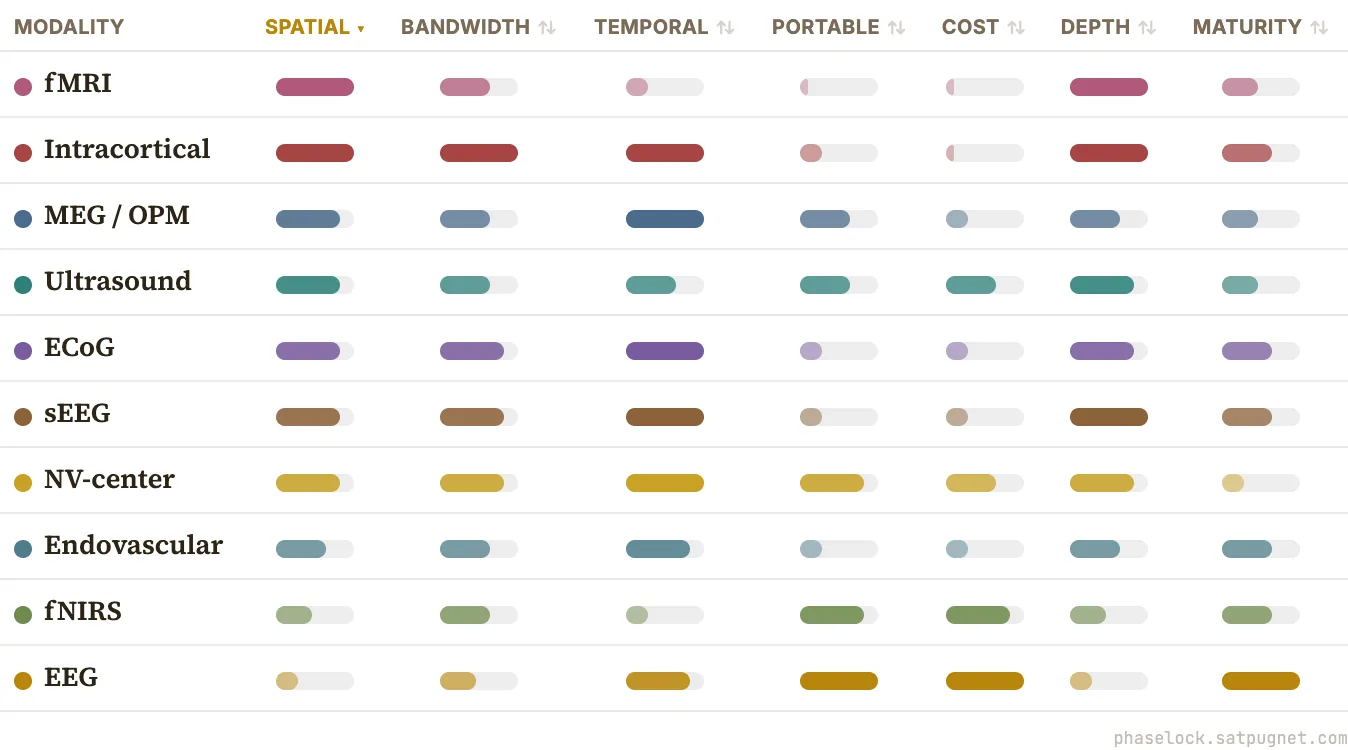 ▸; below is each modality in detail:
The Full Modality Map
Non-invasive BCIs
EEG: Measures electrical activity at the scalp with millisecond precision. Cheap and scalable but spatially noisy, it is the main test bed for early brain foundation models like AllJoined’s.
fNIRS: Uses near-infrared light to track blood oxygenation, an indirect signal that lags neural activity by several seconds. It is wearable, and Kernel is one of its leading commercial platforms.
Ultrasound: Uses sound waves to image blood flow and stimulate targeted regions deep in the brain. Still early, but promising for compact read-and-write interfaces. Butterfly Network put ultrasound on a chip; Nudge and Merge Labs are applying it to the brain.
MEG: Measures magnetic fields produced by neural activity with millisecond precision. Once limited to room-sized cryogenic scanners, it is becoming wearable through OPMs.
fMRI: Uses powerful magnetic fields to track changes in blood oxygenation, an indirect measure of neural activity. It offers millimeter-scale spatial resolution and has enabled some of the best non-invasive semantic reconstructions, but it is slow, expensive, and confined to room-sized scanners.
Invasive BCIs
Endovascular: Guides an electrode through the jugular vein into a blood vessel beside the motor cortex. Synchron’s Stentrode avoids open-brain surgery, trading signal precision for a far lower surgical burden.
ECoG: Places an electrode grid directly on the brain’s surface, capturing cleaner signals than EEG without penetrating the cortex. It has enabled speech decoding at 78 words per minute.
sEEG: Inserts thin depth electrodes into cortical and subcortical regions. Widely used to localize seizures, it has produced large clinical archives of human intracranial recordings.
Intracortical: Inserts microelectrodes into the cortex to record individual neurons, providing the highest-fidelity signals. Used by Neuralink and Utah arrays, it enabled Stanford’s 90-character-per-minute handwriting decoderHigh-performance brain-to-text communication via handwritingImplanted microelectrode arrays in a paralyzed person’s motor cortex decoded imagined handwriting at 90 characters per minute, faster than most people type on a phone. The existence proof that the brain encodes the variables we want.▸ but surgery and long-term durability remain major barriers to scale.
The Future
NV-Center: Defects in diamonds that detect tiny magnetic fields at room temperature. Not yet practical for BCI, but huge potential if we make it work.
Appendix E: Glossary
- ALS
- Amyotrophic lateral sclerosis. Progressive motor-neuron disease; one of the conditions BCI work has historically focused on.
- Bandwidth
- How much information you can send and receive per unit of time.
- Bandwidth gap
- The vast mismatch between how fast machines can think and communicate, and how slowly humans can process information.
- BIDS
- Brain Imaging Data Structure. A community standard for organizing neuroimaging data (MRI, EEG, MEG) in a uniform directory layout. Adoption is still uneven.
- Connectome
- The full wiring diagram of a nervous system: every neuron and every connection between them.
- Diffusion models
- Image-generation models that learn to reverse a noise process: start with pure noise, denoise step by step into a coherent image.
- Dura mater
- The tough outer membrane enveloping the brain and spinal cord. Semi-invasive devices sit beneath the skull but rest on top of this layer.
- EEG
- Electroencephalography. Reads voltages off the scalp. Cheap, ubiquitous, noisy.
- Endovascular
- Electrodes delivered through blood vessels rather than open craniotomy.
- Exocortex
- An external digital layer of your mind that extends your memory, attention, and mental computation beyond your biological brain while functioning as part of it.
- FAIR
- Meta’s Fundamental AI Research lab. The open-research arm of Meta AI.
- fMRI
- Functional magnetic resonance imaging. Room-sized scanner with millimeter spatial resolution; the highest-quality non-invasive signal we have, at the lowest portability.
- fNIRS
- Functional near-infrared spectroscopy. Measures blood oxygenation through the skull using infrared. Cheap, wearable, slow.
- Glial signaling
- Communication between glial cells, the non-neuronal majority of brain cells. Increasingly suspected to modulate cognition, not just support neurons.
- Hemodynamic
- Relating to blood flow. Sensors such as fNIRS read the blood-oxygenation shadow of neural activity through the skull.
- Interpretability
- The effort to understand what happens inside a neural network: which internal features and circuits produce its behavior.
- Limbic system
- A set of deep brain structures that drive emotion, motivation, and reward. It is the circuitry that advertising has always tried to reach from the outside.
- MEG
- Magnetoencephalography. It reads the tiny magnetic fields cast by neural activity. Millisecond timing, but classically needs a room-sized cryogenic scanner; OPMs are a new wearable path.
- Microelectrode arrays
- Tiny silicon chips with dozens to hundreds of hair-thin needles, surgically inserted into brain tissue to record the firing of individual neurons.
- Microtubules
- Tube-shaped protein structures inside neurons. Some theories (Penrose-Hameroff) propose they support quantum computation; mainstream neuroscience is still skeptical.
- Motor cortex
- The strip of cortex that plans and executes voluntary movement. Easiest brain region to decode from, because intentions there map cleanly to body actions.
- NWB
- Neurodata Without Borders. A standardized data format and ecosystem for neurophysiology recordings. The closest thing to a common schema across labs.
- OPM
- Optically-pumped magnetometer. A chip-scale magnetic-field sensor that works at room temperature; the path to wearable MEG.
- Phase Lock Window
- The brief interval between recognizing that AI will surpass us and the moment it does; the span in which humanity still has the agency to shape the terms of the relationship. Roughly now to the mid-2030s.
- Quantum effects
- Hypothesis that quantum-mechanical phenomena (coherence, entanglement) play a functional role in brain computation. Live but speculative, no consensus evidence.
- Ransomware
- Malicious software that encrypts a victim’s data or device and demands payment to restore access.
- RLHF
- Reinforcement learning from human feedback. The training step where humans rank a model’s outputs to steer it toward preferred behavior.
- sEMG
- Surface electromyography. Reads electrical activity of muscles through skin electrodes. Well-suited to subtle motor intent and silent speech.
- Signal-to-noise
- How strong the wanted signal is against background noise; the core obstacle to reading the brain through skull and skin.
- Whole Brain Emulation
- A hypothetical process of scanning, mapping, and simulating a biological brain on a computer so that the digital model functions identically to the original mind.
- wpm
- Words per minute. A standard measure of communication speed.